debt blog

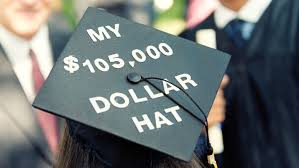
I am going to be in so much debt after college. I’ve gotten a good chunk of institutional aid, and I am still waiting on federal and state aid, but the way things are shaping up currently, I will likely be in six-figure debt at the end of my education. 

That’s pretty crazy. I don’t pretend to be any kind of expert in finances or anything, but I’m pretty sure 100k is a pretty unfavorable number of anything to owe.

Do I have it better than someone else? Of course. I know there are people out there paying the full sticker price of college or going to a school that charges a lot more in tuition. I’m grateful I am in the circumstances I am in. However, I’m still going to be in a lot of debt.

How did it get to this point? 

Yes, I chose to go to this school, being fairly aware of the cost. 

But I mean on a larger scale. In a news report, they said that in the past, a college education had a pretty big percent chance (I don’t remember what, but it was probably 80-90 percent) of helping the graduate make more in the future. However, today, college graduates have about a 50 percent chance of doing better, just because the cost of college is so high that the debt cancels out the benefit in the job market. Isn’t that crazy? You flip a coin. If it’s heads, your college education helped you in the long run. If it’s tails, you just shot yourself in the foot (financially).
Picture Credit: The Public Purpose

Why we chose to do it this way.

Much like the concept of God, Capitalism is a system that cannot be defined by a word. It is not a rock solid object, that can be easily seen or understood. Robert Reich, the former Secretary of Labor for the United States, recently said that the 26 richest people in the world have the same wealth in dollars as the 3.8 billion poorest. 26, the size of the OVS senior class, vs 3,800,000,000, the equivalent population of North America, South America, Europe, Australia, and Africa combined. So basically everything beside Antarctica. Yet this wealth distribution is not specific to the global level. The United States, prided for being a land of economic opportunity and no class boundaries (foregoing the dynamic of ethnicity). But as the year strays farther from the millennium, the more the middle class dissipates, leaving many in a sink or sink situation. Although the political statement-turned-meme “Okay, Boomer” is now annoying and a reflection of the younger side of Gen-Z, the economic proportions of millennials vs baby-boomers are astoundingly different. A common talking point of the difference between these two generations is real estate. At the same age, Boomers owned 32% of real estate in the United States, wheres Millennials owned 4%. (Business Insider). This isn’t just because old people have poor taste. Decent houses for low income and even entry level houses for average salaries are sparse. That, coupled with a stagnant minimum wage and record student debts (paired with record college educations per capita), make it more difficult than ever for Americans aged 20-40 to afford a house. Renting, although disproportionate to inflation, is still a cheaper option.

There are a million other examples of how I could list the caustic nature of the capitalism that we maintain as a nation, but as someone who must soon face these realities, I will stick with the most relevant. I don’t know why we chose to do it this way, but we have the ability to change it yet again. It’s just up to how much we are willing to sacrifice.

Image result for capitalism
Credit: Foundation for Economic Education