the flowers start wilting,
their petals falling into the dry, crackling dirt.
the resilient weeds start sprouting,
entangling their way around the stems of the dying blooms.
that old rose bush that you prized is now riddled with thorns.
i tried to pluck one,
send you a picture of it,
but my fingers got cut up and started bleeding
and i knew it wasn’t worth the trouble.
the single flower wouldn’t bring you back,
why try so hard to make it bloom again?
why keep it in a vase that glistens during the 3 pm glow of the sun?
why stare at it, remembering the day we planted the damn rose bush?
no, i’ll stick to bandaging up my hand,
ridding it of the metallic red,
dripping down my palm,
almost staining my pants.
i’ll stick to staring out my kitchen window at the garden, once blooming,
now only a couple of rotten, lonesome plants.
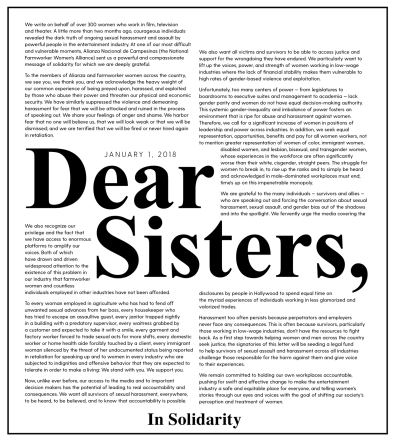
At this year’s Golden Globes ceremony, the usual sea of colorful ball gowns and loud accessories were missing from the red carpet. Instead, all but three women wore completely black dresses.
Photo Credit: timesupnow.com
Their dark choices were in accordance with the Time’s Up movement, founded on the first of this year, in response to the Harvey Weinstein allegations, with nearly 100 women accusing him of misconduct, and the #MeToo movement. Its mission statement is as follows:
“TIME’S UP is a unified call for change from women in entertainment for women everywhere. From movie sets to farm fields to boardrooms alike, we envision nationwide leadership that reflects the world in which we live.”
The movement is backed by hundreds of actresses and other entertainers, who sent out a massive social media campaign on New Year’s Day. Just a week later, they all donned their midnight black dresses in protest towards the years of abuse faced by many female entertainers. Since then, they’ve inspired the adornment of white roses at this year’s Grammy Awards.
Ironically, many men who donned the Time’s Up pins with their black suits at the Golden Globes have since been accused of sexual misconduct, such as Aziz Ansari and James Franco.
Many Time’s Up activists were also present at this year’s Women’s March, which was held on January 20. With notable speeches from Natalie Portman, Viola Davis, and Halsey, the massive crowds got even more heartbreaking first-hand accounts of the grotesque incidents found throughout the industry.
With all of these very public protests, people are finally recognizing years of sexual misconduct from producers, directors, casting agents, and more.
It is abhorrent and dehumanizing for a person to be put in the position of having an undeserved, unwanted sexual encounter forced upon them, with health of their career being at stake lest they say “no.” When a thirteen-year-old actress receives a rape fantasy in her fan mail, as Natalie Portman recounted in her Women’s March speech, she loses a slice of innocence that she cannot get back.
Foundations like Time’s Up are certainly bolstering this movement, making the harsh reality of the age-old misconduct much more public than previous years. Finally, sufferers of sexual assault are being heard.
This year, I’ve already seen so many cases against previously respected men. Harvey Weinstein was fired from his company following an article published by the New York Times and Kevin Spacey was removed from the fifth season of House of Cards.
Finally, abusers and rapists are receiving repercussions for their actions. Not just in Hollywood, but throughout many different industries.
On January 24, Larry Nassar, former Olympic doctor, was sentenced to another 40-175 years in prison (added to his 60 year sentencing for child pornography possession) for the decades of molesting and raping young gymnasts under his care. Notable athletes, such as Aly Raisman and Jordan Weiber, have spoken out against their abuser, even appearing in court to deliver impact statements.
With so much awareness, the time for change has come. No longer can we sit idly by when a man or woman is accused of assaulting another. No longer can we support known rapists. No longer can we support sympathizers of abusers.
While Time’s Up is a good first step, it’s the first of many we have to take to reach change. If a victim comes forward, they have to be taken seriously. They have to see that their bravery is matched with justice.
Woody Allen, who has been accused of sexually abusing his adopted daughter, Dylan Farrow, is still making films. While many actors have spoken out against him, he is still in the industry.
Casey Affleck, who went to court for sexually harassing two women back in 2010, won best actor last year. However, he has been asked to not present at the 2018 Oscars this year.
Melanie Martinez was accused by former best friend Timothy Heller of being raped, but Martinez fans instantly shot down the victim’s narrative, calling it “attention-seeking” and “jealous.”
Lena Dunham has admitted to experimenting sexually with her little sister in her book Not That Kind of Girl. However, she still went on to act in another three seasons of hit show Girls and continues to act in many other projects.
Another sad reality is that too often people across all walks of life are being abused. Sexual misconduct isn’t a “Hollywood issue.” Everyday, thousands of people in offices, farms, bus stops, stores, schools, and even in their own homes are being sexually abused. The issue goes beyond what 300 celebrity signatures can achieve.
No matter the instance, thousands of victims are still being de-legitimized daily. No amount of colorless attire can deter from the sad reality that every 98 seconds an American is sexually assaulted. No amount of celebrity endorsements can stop the years of distress faced by victims after their assaults. While time’s up for sexual misconduct, it’s been up for far too long.
The audience hushes as the red, velvet curtains slowly open. There is only a single, shining light poised on a girl. Her tight ringlets framing her face fall out of her rigid ballerina bun. Her soft, lilac dress glistens in the beam. Her big, green eyes glitter.
With a fast, sharp note from a hidden violin, the girl raises, kicking her leg straight in the air, while rotating her pointed foot, still on the ground. Her pointe shoes move in a flurry, fluttering left and right across the stage.
A minute later, her feet finally meet in a plié, as she bows and scurries off the stage. I am the first to stand up and cheer for the girl, my daughter. I meet her smiling face in the hallway, after the performance, bringing her into a warm embrace and handing her an outrageous bouquet of white roses. My eyes well up at the sight of her. I snap a picture to remember this moment.
My pride and joy. My little girl. My partner in crime. My little ball of sunshine.
Photo Credit: pinterest.com
I cannot see into the future, see what job I’ll have, see where I’ll call home. My crystal ball is currently out of order. However, I’ve never seen my life without a child, without a family. I can’t see all the holidays, filled with scrumptious meals and plenty of presents, without a husband and daughter; the winter days with warm sugar cookies fresh out of the oven; crudely-drawn crayon masterpieces covering the fridge and the Polaroids of every little moment lining the hallways.
I dream of my son asking someone to go to prom, my daughter’s soccer team going to play-offs. I can see my son going on tippy-toes to shove a bundle of Christmas cards into the mail, snow falling on his button nose, turning his skin pink. I want to help my daughter learn to walk in heels, laughing as she trips over her own feet.
I see this future as I write letters to my future children, as I jot down names in my phone. I see it in the pride in my uncle’s eyes as he saw his daughter graduate college. I see my future in the plethora of Facebook posts from my aunt.
So, I don’t know what my future holds, nor do I want to. Maybe I’ll score a job as an astronaut or an author, but I do know that what I want, more than anything, is a family of my own that I can celebrate the news with.
Please stop making shows/ movies about mental illness willy-nilly. Coming from a girl with clinical depression and anxiety, your depictions never get it right. I’m a sucker for any entertainment, especially your notoriously binge-worthy shows, but your new affinity for “starting a conversation” and “bringing awareness” to such prominent issues is doing more harm than good.
Photo Credit: hollywoodreporter.com
First, let’s start with the insanely popular 13 Reasons Why, which follows the events that “led up” to junior Hannah Baker’s suicide. Back in May, when I watched the show, I felt disgust whenever it was brought up. I had watched it because I was so excited to see how a major platform, like Netflix, could start a trend of accurate representation of mental illness in the media. To my dismay, this show became another failure. I wrote a lot about this show in a previous blogpost, but I have a few things I forgot to mention. Besides being extremely triggering for those with suicidal ideations and/or depression, the show’s creators forgot to think about the very real consequences of putting out what they did. In the two weeks following the show’s release, searches relating to suicide, such as “how to commit suicide” or “how to kill yourself,” went up over 19%. To put it into different numbers, about 1.5 million more searches were made relating to suicide. Yes, these statistics aren’t exactly the show’s fault, but such a dramatic spike had to have some catalyst. Also, many teenagers and adults started performing “copycat” suicides or suicides that resembled that of Hannah Baker’s. For example, a 23 year old man committed suicide and left behind 13 audio recordings assigning blame to people he knew for their part in his suicide. You can’t possibly tell me that he didn’t have any persuasion from either the book or TV show. Since the show did not follow guidelines from the World Health Association, a very reputable expert of health in my opinion, on how to portray suicide in a healthy, non-triggering way, many people have faced grave fates on the creators’ behalves.
Moving on, Netflix most recently released a show, Atypical, about a senior in high school with autism. I, again, watched the entire season, very quickly I might add. Sam, the main character, navigates the new world of dating, which involves getting his first girlfriend. He and his girlfriend, Paige, have a sweet relationship, but it all ends when he admits his love for his therapist, Julia, in front of her entire family. Writer Matthew Rozsa writes about how grotesque this specific incident is, among the many others of show. “These aren’t classic signs of autism — they’re violent, creepy, cruel and make the autistic character seem like a monster. When the show then shifts gears to make us feel sorry for Sam, the characterization becomes more offensive. Arguing that those with neurological conditions shouldn’t be held accountable for hurting others is as patronizing as it is socially irresponsible,” he said. Sam even says that autistic people don’t lack empathy, which is very true even though many on the spectrum can’t physically or verbally express it, but some of his actions contradict that. The Olive Garden scene is an example of it, Sam, being as high functioning as he is, couldn’t realistically not see his wrongdoings, as shown by his overall awareness throughout other parts of the show.
Photo Credit: collider.com
The show also follows the lives of Sam’s family and how they have to accommodate him. This is one of the only things that is represented fairly and realistically, as an autism diagnosis doesn’t mean that loving, sarcastic, silly dynamics of family go away. However, this notion that autism is an issue that affects everything about a family’s dynamics is very harmful. Although I don’t have anyone in my family with autism or personally have autism myself, I know that living with this disability is tough. Not only is it hard to function in the world, the stigma that comes along with it is also extremely hard. That’s something this show forgets about. In trying to make an accurate representation of autism, the creators forget to get to the true depths of the disability. While writing this post, I had a long conversation with one of my friends about the show. While she doesn’t have autism herself, some of her family does. What the show misses is the fact that autism has a huge toll on the families it affects, but also the person. Actor Mickey Rowe tells of the gross misrepresentation of this notion. “Sam is a high school senior at a regular school, and he doesn’t use an assistant or paraeducator, so he’s largely independent. Yet his parents seem to hint that they haven’t been able to go on a date since he was born, implying that they’ve sacrificed their own lives to help him through his. What’s more, they talk about Sam as if they don’t have anything in common with him and at times appear to present their son’s autism as a tragedy,” he said. The show lacks the rough toll autism has on the individual, even though there are plenty of first-person accounts they could’ve included in it.
The show claims Sam is high-functioning, but his symptoms are all over the place. In a series of interviews with autistic viewers of Atypical done by The Mighty, Lamar Hardwick, who is on the spectrum himself, explains this perfectly. “There were parts of the episode where I felt some autistic traits Gilchrist [Sam’s actor] displayed were a bit too overstated. While the actor did a pretty good job overall, issues such as lack of eye contact and taking things literally started to feel like a caricature of autism. I’m not sure that an autistic person would always see themselves in that light,” he said. Although the show means well, it makes autism into an anecdote, focusing on common symptoms, to provide a goofy portrayal of Sam’s autism.
You’re left with a character who is kind of a jerk and has an overly-dramatic version of what autism really is. It’s even worse when you see how his family’s characters are much more developed and multi-faceted than his. Possibly the biggest fluke in this show is that none of the creators have autism or a family member with it. Instead, the screenwriter and executive producer, Robia Rashid, “had to do a lot of research.” Research doesn’t always lead to accurate findings, though. Sadly, this show missed the mark about how real autism really is.
Photo Credit: ew.com
Now, I may be coming off as extremely negative, but there is one show (well, movie actually) that I wanted to finish my letter with. That would be To The Bone. Again, this movie doesn’t get the eating disorder Anorexia Nervosa 100% correct. The main character, played by Lily Collins, is a young, privileged, white, and skinny girl who has divorced parents and extreme family issues. This movie had the opportunity to showcase a fat, unprivileged grown man or a person of color with the same disease to show that it doesn’t just affect those that look like Ellen, Lily Collin’s character. As far as eating disorders go, anorexia is very prominent in the media. There are so many movies and books talking about this disease. What I liked about this movie, especially compared to 13 Reasons Why and Atypical, is that the director and the main actress both have had anorexia. An article from Variety magazine describes Marti Noxon’s, the director, accurate portrayal of the disease as, “ [not an] especially pleasant movie to watch, but it is one that just might save a few lives.” What you get when you watch To The Bone isn’t some linear progression to recovery, but an extremely up-and-down diegesis that ultimately shows that recovery, something that is desperately needed when dealing with an eating disorder, is worth it in the end.
One thing I like to mention before I finish, can you tell me one thing these characters have in common? I hinted at it in the last paragraph. Still guessing? They’re all white! Not only is the media containing a complete lack of representation of mental illness, gender, sexuality, and people of color, but you never see a culmination between any of these themes. GLAAD does a very well-rounded data analysis of misrepresentation in media overall and I recommend you check it out. Netflix had a wonderful opportunity to create shows with directors and actors with these disabilites/diseases. They have all different kinds of actors willing to be a part of any media they create and while I applaud Netflix for their overall diversity, they still missed the mark when it came to these shows. The only people of color I remember in these shows are Ross Butler’s character in 13 Reasons Why and a fellow member in Ellen’s inpatient facility who happens to be black. The representation of these characters would’ve done way better in terms of conversation if they changed the way society traditionally sees these challenges. Make Hannah Baker a lesbian, Asian girl who has unforgiving parents. Make Sam black and underprivileged, not having the ability to hug his older sister. Make Ellen/ Eli an adopted, obese girl whose family couldn’t see her illness because they weren’t educated. Create new conversation by adding in REPRESENTATION. Youtuber Annie Elainey puts this into perspective perfectly.
I finish with a plead. While these movies and shows are indeed raising awareness, they have to deal with their subject matter delicately. Mental illnesses, eating disorders, and other disabilities affect too many people to be taken so lightly. What all these people need is a positive, accurate depiction of their lives. They don’t need uneducated producers and directors making stories that they can’t connect with. I love that Netflix is trying to help, but I suggest, like what To The Bone did, that the creators of these shows know what their subject matter is like. Research and conversations don’t even compare to those living with it. No amount of paper can match the grief of another hospital visit. In order to create something with truth, real experiences need to be showcased.








 OVS Journalism Blog
You must be logged in to post a comment.