Fair Harborside (2)

Read Part 1 here

Below Amelia and beyond the borders of her glass and marble version of the city, the eyes of the workers were cast in coal and ash. Those of the slums were fading out of being, becoming just blurs, wisps of subconscious, hollow. They were being emptied of dreams, emptied of light, emptied of value. They looked – with light-burned, cataracted eyes, weary and broken from too many hours in front of a forge – toward the city they had dreamed of, the one they believed in, the one they were now part of, the one now using them as a whetstone to hone itself upon. They looked upon a city alien and yet familiar; one that shared the same name, shared a people, but was separated by a wall of prosperity, an insurmountable barrier of capital value.

Rising above Frank was the very tangible feeling of success and dreams realized. Above him – wrapped in their own private worlds, curtained off from each other – lay the world of Traders and Merchants and Moguls. There was no lost space, everything was worked to perfection, commodified and able to be owned. People had become slaves to their Ikea nesting instinct, they simply filled the space given, even the ultimate consumers did not own their space. The streets were wide and clear, everything at a crisp ironed angle, a city of well pressed pants. Those who walked them did not know each other beyond image: a Trader by the scale lapel pin, an Artist by the garish socks, an Economist by the gloves, a Mogul by the hat. On the great rising monoliths movies and media played, any new information came from those gargantuan marble monoliths. The world beyond Harborside was found in those rising towers of media.

But in the slums – from the roofs of their squat and makeshift shanties – the workers could just glimpse the edges of media. Their world was full of cracked screens and secondhand news. People were cramped, the heartbeat of one encroached on the next. The global world had all but disappeared to them, where they had come from was being wrung from them as they became just another road stone in the city. The cultural identities they had brought with them, had created neighborhoods around, had found their first jobs with were bleeding away. They were becoming the masses of the city, overwhelmed by the need for money, the vast cost of living had ensnared them, had separated them and pinned them by the wings. 

Photo Credit: pinterest.com

But the global world existed only in the harbor with the monoliths of media, with the bustle of trade, it was rich and thriving in the harbor. Money was not lacking, it seemed as if the less work one did the more money filled their coffers.

Frank was well off for a country boy, so when he docked in the sand of the fish market – the only place his little decrepit rented dinghy could -he was sure he could do anything he could possibly hope for. As he jumped from the boat he sunk to the knee into rotting, bloated, sun-blistered fish waste. His nose crinkled, What a welcome. He trudged upward into the city, tapping his breast pocket with a light rhythm. As he reached the paving stones his tapping ceased, he could not crane his head far enough, the city just kept going. The longer he stared the more his past months at sea ebbed away with the tide; his past was being drowned out by the sounds, the smells, and the people. The city was made of individuals from the ground, Frank was just another one of them, just another in a sea of people striving to flourish as themselves, he was just dressed a little more shabbily, a little more wide eyed, a little more idealistic, he was just a little bit poorer, he was just woefully unprepared. So he set out to wander the city, to find himself, or lose himself.

Fair Harborside (1)

It was dingy as hell, not recognizable as the city everyone saw in the postcards: moss and algae crept down the walls; the side streets were lined with open sewers; the factories ran all hours of the day, belching out waste and haze. Soot streaked down the faces of the workers whose hands were cracked and brown with exposure. What little they had they called home, whether roof or coat, they took what they could. They struggled through narrow congested streets, seemingly stuck in the past — a bygone era, that had long since been passed by the rest of the city — an open sore without medicine.

On these congested streets lived all manner of discard: tech no longer current, factory waste, dreams of fame and fortune, the relics of the country people once left, heirlooms of cultures long swallowed. But as the streets turned oceanside they widened and lightened, the haze of smog dropping away the closer one moved to the harbor, the mecca of trade, the jewel of the city, the picture perfect postcard. Harborside was a world of glass and gold that rose high enough that those with bloodshot eyes and wasted dreams believed that maybe it reached heaven.

The city of Harborside was rich, modern, urban, cultured, and only surface deep. Every man, woman, and child that lived in the skyward reaching world was a dreamer, a planner, a story. Their streets were lined with rare plants and their roads paved with exotic shell. Every home was its own, sitting pretty at the height of progress. They would want for nothing and everything.

Such severance was there in the city of Harborside that it was as if a blight, a disease, had been stretching out from the landward outskirts of the city but had abruptly hit a vaccine three quarters of the way toward the harbor. It was as if an immunization had been injected into the sea and had spread to the seafront but had been content to protect the few.

Photo Credit: steemit.com

Life was bobbing at a sea-sickening rate as Frank finally found the city. He had taken every form of transport available to him: car, bus, train, plane, his own two aching feet, bicycle, and finally boat. As the city rose over the bow of the leaky, decades-old fishing boat, the tug behind his gut seemed to loosen. The folded postcard in his breast pocket was a molten brand of hope and childlike optimism on his heart.

Life had ground to an overly warm stagnate existence for Amelia. Trapped above the cloud level – in a glass box – Amelia had the entire world at her fingertips. She was at the height of modern technology, she was as mapped out as the best planned city. There was no one like her, there never had been another like her, nor would there ever be one like her. She was a road map. She was not her own. She was caught, ensnared. Made and unmade.

The Party at the End of the Summer

It was oppressively hot, but it was worse inside. The idea for the party had been born earlier that month, straight out of the heatwave, full of desperate loneliness and braised, salted wounds. He had thought that the heat had been bad when the party was thought up but it had gotten worse, the end of summer was supposed to bring promise of a cool refreshing fall, but instead the dog days were holding on.

Partygoers were wilting like flowers, falling and rising in dance on a phantom wind born and nursed by too-expensive-booze, and sweat dampened morals, the peace was tenuous. It was just too hot for a party, even the breeze was like licks of fire on his cheeks.

The rail of the balcony scorched his forearms, but it was better than dancing in the heat. He dropped his head back and looked for stars he would not find, but before the search even truly began the click of heels sounded behind him, the echoes of a last ditch S.O.S in consistent and aggressive morse code.

He did not look, she came up to the railing next to him. He still did not look at her, but in his peripheral he could see she was reasonably tall, dressed in unseasonal black, sleek. She inclined her head and stared out into the darkened hedge maze below them, all shadow. He could sense her grace rather than see it, there was something indescribably elegant in her presence, but she was incredibly still. She was pensive in a way that only people dressed in finery and malcontent can be.

She looked on as a couple stumbling their way through the doors below them, tipsy, glittering and very much in love made their way into the maze. Both were dressed in crisp autumn colors, one a in deep burgundy gown that splayed behind her like a trail of fire and the other in a warm burnt orange that fell like water.

Photo Credit: previously.tv via Penny Dreadful

Two leaves dancing in the too warm night, lost to the world and unregistering of the weather outside of their perfect dichotomy.

She glanced sideways up at him through the leaden air, her sharp, slanted eyes caught him off guard, caught him staring at her with the sideways glance of someone interested but unwilling to admit it, but her interest was clear.

He slid his eyes lazily away and turned so his back was to the railing. She turned her head to see his profile, if he glanced at her out of the corner of his eye again he would see almost her whole face, a dangerous temptation. He hadn’t really seen her yet, the tendons in his neck lightly pulled him to look at her, but he resisted, he vowed not to look. He didn’t want to talk to anyone, especially not at this party.

She sighed, a light huff of hot air in the even warmer atmosphere around them, the air around them weighed heavy on him, even the light seemed dragged down. She leaned her narrow gloved hands on the bannister the stem of a champagne flute nestled in her long, lithe fingers.

She was made of long lines like an artist had just drawn out the essential curves in stark black strokes, she flowed like fine ink.

She swirled the champagne in her glass, light winked off it catching the light like a star on earth.

“This is the expensive stuff and what a glass to put it in.” Her voice was low and rolling over him, lulling him into a stupor, “The cost of the wine almost justifies the dressing up, but this glass, the glass definitely justifies the dressing up.”

A sudden shattering caused his trance to break, his vow forgotten his head snapped to look at her.

From her elegant and bewitching fingers the glass had fallen, no, he realized as he looked at her small smirk in profile, the fine crystal glass had been dropped, on purpose.

A galaxy now lay on the stones beneath them, the leaves in the maze had also turned suddenly at the clear cold noise cutting through the heat, but they were once again lost to themselves within moments.

He was now staring into her eyes, unable to look away, pinned like an insect to a scientist’s board, her dark brown eyes looked almost black under shadow and tapered lids.

He spoke one word, his voice rusty and thick with the overly warm air, “Why?”

She glanced down and turned on her heel, her sharp cheekbones and nose flashed in the light of the windowed doors she was headed toward, now that he had looked at her he could not look away. Those inky outlines were nothing on the amorphous night she was truly made of.

“So you would look at me,” she walked through the doors then, the promise of a cool fall night disappearing into the light of a too hot summer party.

“Beautiful”

While it may sound vain, despite being relatively confident, comfortable, and even sometimes feeling rather pretty, I don’t think I’ve ever felt fully represented as “beautiful”. It frustrates me that so much of my already fragile confidence could be tied to media, movies and t.v shows but it kind of is.

Part of me feels like the culture I grew up in does not believe me to be “beautiful”. I’m not western enough, in fact in personal experience when I see an East Asian in a show or movie, while my heart does glow, they are usually mixed race or distinctly more western looking than I or many other East Asians look, so in a way I guess I’m used to feeling sidelined for a more western standard. Which is probably why I’ve never felt that en masse the American.

I often wonder: have I have been conditioned from childhood to see myself as too East Asian to be considered en masse “beautiful”? I have this fear that there will always be that “for an Asian” tacked onto compliments about my appearance or just the “oh she’s Asian” exclamation. I’m not sure when this would/has befall/en me but it’s still become a very real insecurity.

Photo Credit: Martin Taylor Home Page

The older I’ve gotten the more I seem to notice that I’m not sure where I fit, there’s always a twinge when someone asks if I’m an exchange student or to translate something for them, that’s in Korean *cringe*, but hey perhaps understandable transgressions, but still, really?

I don’t see myself reflected back when I see “beautiful” people on the t.v or in books or in American pop culture. When people make lists East Asian are woefully lacking, the part of me that is fed off of pure media is constantly being told that people who look like me aren’t really that beautiful.

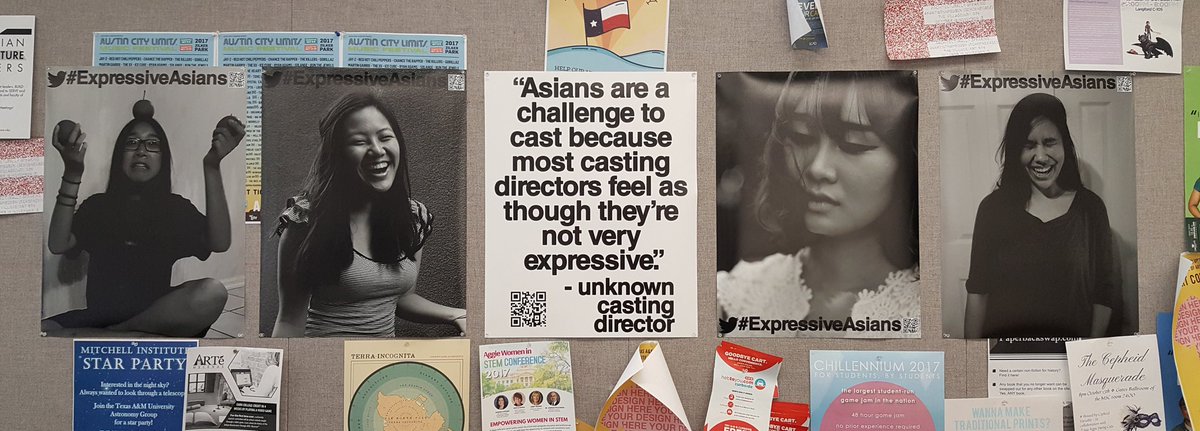
I’ve talked about white washing before, but this year I was hit with a whole new wave with the twitter #expressiveasians.

An unnamed casting director is cited in Nancy Wang Yuen’s book Reel Inequality: Hollywood Actors and Racism, as having said, “Asians are a challenge to cast because most casting directors feel as though they’re not very expressive.” As much as this statement kind of makes me want to laugh, because who even says sh*t like this? The more I sat and thought about it the more it shocked and … hurt.

Photo Credit: Twitter

I’ve always been slightly insecure about my smile, how small my eyes get when I laugh, I mean just my face in general, but this comment, despite the amazing retaliation from many proud Asians on the internet, just hit hard and not even where it was necessarily directed.

It hit me in a way that I can only liken to feeling like taking a photo with friends looking at it and going, “Oh god why do I look different, why do they all look good while I look so ugly?” It’s just the feeling of being the odd one out, in the case of Expressive Asians it’s being the perpetually non-expressive race.

It’s a kind of reminder that says even if you feel the same you definitely don’t look like it!

While I am in fact Chinese-American I’m not mixed race, I am full blooded Chinese, but I’ve grown up in America with Caucasian parents, in relative white privilege, so I’ve always been stuck between two worlds. I think and act like an American but I realize that people don’t see me as American until I open my mouth and even then sometimes they don’t. It leaves me to wonder about how I feel about myself, how does America as a culture feel about me?

Is it too much for me to want to see myself reflected back from the screen without the aid of cartooning? Is it too much for me to see someone like me be considered “beautiful” in American pop culture?


The Summertime Blues

The summertime blues whisper to me,

they caress and seduce,

they ask

Am I going to regret that?

Photo Credit: Chicago Blues Bar


Not taking them up on that offer.

Am I going to regret what I’m doing to myself?

Am I doing it to myself?

Is there something wrong with me?

Why am I no good at conversation?

why are you boring?

Why do I feel that when I open my mouth everyone is just waiting for me to shut it?

Why do I think a helping hand is offered in pity, forced on by “good will”?

because it is.

I tag along on other people’s words.

Photo Credit: Forensic Medicine for Medical Students

how annoying can she get?

I can’t meet people’s eyes.

what if they actually see me.

no, I want them too see me.

do I?

so, eyes flit away.

Do my hands shake or do I imagine that?

Why does it seem easier to go it alone than to give people the chance to push me out?

Why does it feel like everybody stares?

Photo Credit: Harvard Business Review

All eyes on me.

no eyes on me.

no eyes on me.

delusion to assume you took center stage, the spotlight’s not on you it’s on the person next to you, Narcissus. 

No words left.

Their eyes and hearts and minds wait, full of pity.

But what if I didn’t give them the chance?

But what if I didn’t give them the chance?

IT : a review

*Contains spoilers

IT, where to start? Born from the brain of literary machine and titan Stephen King, IT is the story of how fear and childhood trauma haunts people into adulthood. Written out, the entire story takes about 1,100 pages and is quintessential King. So, when Andrew Muschietti declared that 2017 would see IT reborn exactly twenty-seven years after the television adaptation the world of King fans was ready to see Pennywise again, ready with a bit of trepidation.

Photo Credit: wikipedia.com

To take on such a gargantuan story would be daunting to anyone and considering how long an IT remake has been on the drawing board it is a bit of a gift and surprise Pennywise even made it to the big screen.

While overall an enjoyable and successful adaptation there are a couple of definite flaws that despite solid casting, genuine chemistry among the young actors and overall success must be discussed.

But before the long haul starts, there is a shorter review by Time Magazine: here.

Now buckle up and let’s get this show on the road.

It was a brave decision to take on Tim Curry’s performance as Pennywise and with twenty-seven year old Bill Skarsgård in the role most of the pedophilic undertones of Curry’s older Pennywise were buffed out, but that still leaves a child eating, embodiment of all the hatred and evil in the hearts of the Derry folk that is Pennywise the Dancing Clown, so all in all still disturbing and skin crawl worthy.

While Skarsgård did a wonderful job as Pennywise, the physical appearances of Pennywise throughout the movie lacked the true terror of the novel and the manipulative taunting of the T.V. series. As the 2017 movie tried to combine the two it came up seemingly empty handed, lacking true all-chips-in terror of the source material but equally lacking the restraint and presence of Curry’s.

But again compliments must be paid to Skarsgård, whose clown face is possibly more terrifying without the makeup and skull cap. His take on Pennywise is unique from Curry’s and is definitely akin to the book’s. He gave a convincing and often times pitch perfect performance, marked by a genuine understanding for the character of Pennywise and seemed to understand the inner, festering motivations in a way the Curry never did. But alas, Skarsgård’s Pennywise was sadly marred by timing and strange cut offs that lacked the tension and drama of a true chase.

Given the enormity of Muschietti’s challenge slack must be cut for the adaptation. 2017’s IT focuses solely on the childhood half of the novel, an effective and advantageous decision for pacing and continuity. By cutting the novel in half and detangling the time lines Muschietti gave himself room to build the relationships and character arcs of the Losers Club, but even that seemed to lack oomph.

Photo Credit: comicbook.com

That being said since Muschietti was adapting IT for the silver screen not the small screen the development of the complexity in the kids, the parents and Pennywise were lacking. The adults were blatant and lacked subtly, the kid’s character development was simplified and hinged on singular moments instead of many. Pennywise was parred down to just a very scary clown rather than a symbol for racism, homophobia, of the hatred and fear that can inhabit very real people, but this simplifying of a complex character, simplifying of fear, is not unique to just 2017’s adaptation, the 1990’s T.V. adaptation was lacking as well.

Due to the time constraints of a conventional movie the Loser’s Club as a group also suffered. The time that could have been spent building the club into the truly loyal and incredibly strong group of friends it is in the book and even the 1990’s version seemed to be spent focusing on the “maybe” relationship of Beverly and Bill, important yes, but it should not have occupied as much screen time as it did.

Even worse though was the final show down’s use of CGI, a slapdash attempt to use all the new fangled tech available, the final “We all float down here” was taken too far. It was an unnecessary, overt and a lazy just-for-shock effect.

>> A Brief Interjection: If one is going to make a point about racism, one should not drop a one liner into a script like throwing in the gym towel. Racism is a complex topic that in order to land right and meld with a story must have development behind it. The line dropped by a mad and Pennywise influenced Henry Bowers felt like a sore thumb, out of place and awkward. The line lacked any build up or support from the rest of the movie. No back to CGI. <<

The use of CGI for the floating children, Pennywise’s floating blood and his final “diffusion”(?) cheapened the essence of what Pennywise is, it sucked the emotional weight from the final showdown and made it a fight of the supernatural alone, it takes the symbolic humanity out of the fight.

Photo Credit: shockmansion.com

The CGI also stole from the kids the sort of finality of facing their demons, of facing Derry. Muschietti gave Pennywise the benefit of a mystical “death”, admittedly Pennywise is fated to return but he needed to slither away like the pathetic creature he is by the end of the show down, not ambiguously dissolve like some dramatic end for the weight of story to land properly.

Now it may seem like this is about 900+ words just bashing 2017’s IT, in part that is true, but in all honesty despite the flaws the movie is an enjoyable one, it is all in all a very good movie, well worth the price of admissions and perfect for the upcoming Halloween season.

End of the Year

The end of the year is a strangely lonely time.

You know that people will be leaving, projects are due, and so is all the school work from the past few months that you’ve hidden under your bed in denial. So I find myself strangely lonely, isolated even.

But I’m ready for summer, and my introvert battery needs a recharge. You’d think being “isolated” now would help, but it’s different.

Right now I’m isolated by work and change, in summer – recharge mode – I am isolated by choice and enjoyment of being alone. It’s different.

Photo Credit: npengage

Given the choice, I would skip the entire last two months of school, jump straight into summer and then into the new school year. But alas there are the last two months.

I don’t really like change, and maybe that’s why I isolate myself – at least I think it’s a self driven isolation. I hope it is, because the alternative option is that no one likes me. But that’s beside the point. I don’t like change because it takes me a long time to warm up to anything, and change is like a bucket of ice water on what tolerance and comfort I build up.

I’m not saying change is bad, I’m just saying I don’t like it. On top of that, I hate goodbyes. They’re often mushy and huggy and declarative, definite, final.

The end of the year approaches, and I feel kinda lonely and things are changing, fast.

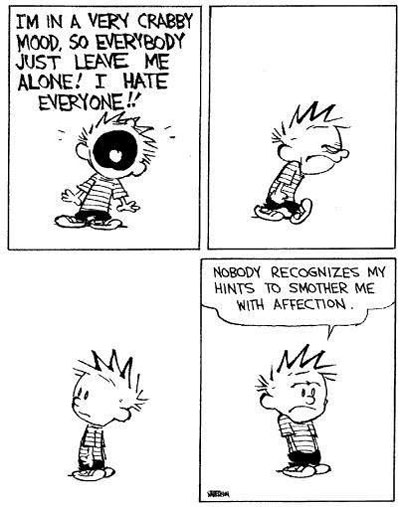
How Calvin and Hobbes Grows With Me

When I was in elementary school I first encountered Calvin and Hobbes. Since then it has resurfaced in various parts of my life surprisingly more and more topically.

Bill Watterson’s perennial comic often addresses the problems and anxieties of growing up, the pain of reality, and everything in between.

Watterson manages to cleverly address issues that still persist today through the eyes of the constantly adventurous and surprisingly observant six-year-old boy.

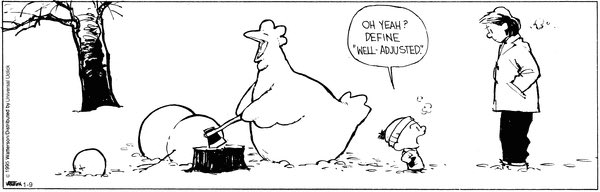
To this day, I find myself enjoying the comics in spare moments, pulling out weather-beaten copies with broken binding hoping to find a laugh or something to prove that I’m not just panicking, that growing up is indeed hard.

Watterson manages to perfectly characterize the angsty feelings of growing up and having to face oncoming reality, and sometimes it just makes me laugh and feel happy despite the panic I feel about having to continue to grow into adulthood.

But my personal favorite remains the very last panel Watterson ever drew for Calvin and Hobbes:

THE DARK TOWER IS ALMOST HERE

2017 IS SET TO SEE STEPHEN KING’S THE GUNSLINGER COME TO FILM. Additionally, with a gorgeous, gun-toting Idris Elba at the front and center.

Set to release in August, The Gunslinger is a source of great excitement and anxiety. Like any other book-to-movie transition, fans are left to wonder how much is going to be cut out and how much is the studio going to eff with something we love?

But in King’s own words, “I feel more wrapped up in this one because the books took so long to write and the fan base is so dedicated. I’m 100 percent behind it — which doesn’t mean it necessarily will work, just that it’s a good way to try and to get into these stories.”

King even approves of the casting. “It was great to see Idris Elba as Roland. He has terrific focus and tremendous energy as Roland. Mathew McConaughey is very scary and very intense as Walter. I love that right away you set up the tension between the two of them.”

Another mark in favor of this movie is, according to Entertainment Weekly, “co-writer Nikolaj Arcel, a Danish filmmaker who says he learned English as a teen just so he could read King’s books in their native language.”

The novel sees Roland, the gunslinger, and Jake, the boy crossing the desert in search of the Man in Black, Walter. Filled with dark subplots and set in a world possibly just adjacent to ours, The Gunslinger movie will have at its fingertips a uniquely open plot to fiddle with.

The first book, for which the movie is named, leaves many questions unanswered and is essentially 300 pages of set up for the rest of the epic series. That being said, the movie will have a lot of room to fill in details and separate non-book plots. In fact, it seems to be bringing in elements from later books like The Wolves of Calla and is possibly missing characters like Susannah and Eddie, but whether the movie adaptations will continue may alter their M.I.A status.

But whether or not one looks on with trepidation or excitement, from the looks of the trailer, the world building is incredibly detailed and all the hardcore gunslinging dreams of fans are front and center.

AC/DC

“Highway to Hell”…”Dirty Deeds Done Dirt Cheap”…Nikola Tesla…Thomas Edison.

The age-old debate of Tesla vs. Edison.

While many don’t care and are just thankful for rock music, we should light the debate on which inventor is better.

Edison is the forefather of direct current (DC) and believed that Tesla was insane for even suggesting alternating current (AC), but in the modern world we live in, AC/DC currents are symbiotic.

The fuel added to feud fire is the rumor that Edison claimed he would pay Tesla $50,000 dollars if Tesla could improve Edison’s Dynamo, when Tesla worked for him in 1884.

Photo Credit: Think Geek

When Tesla succeeded, the rumor goes that Edison refused to pay him, claiming, “When you become a full-fledged American, you will appreciate an American joke.”

In the case of Tesla and Edison, sometimes people just rub you the wrong way. Both men were habitually egotistical but hated the quality in the other. They had vastly different work styles that constantly ran up against each other, and they ended up going head-to-head in fundamental electrical engineering beliefs.

I often wonder how the two men would react if they were able to see how their two ideas have been combined in the modern world.

Would seeing the symbiosis lead them to create another smear campaign, or would they nod in appreciation of the other and not say a word?