I am one person out of millions. I may be small, but my voice will not be silenced. We will no longer be silenced by beliefs made centuries ago.
We will not be silenced by beliefs that are killing innocent lives, or by the beliefs that are discriminating against the people who are finally becoming proud of who they are.
We are the new generation. We are the millennials, the Gen. Z kids, and the generations to come, and we are proud of ourselves for the world we’re determined to create.
We may be young, and we may not know everything about the world, but we are still learning, still improving, and we are definitely still fighting.
We are strong
We are resilient.
And we are powerful.
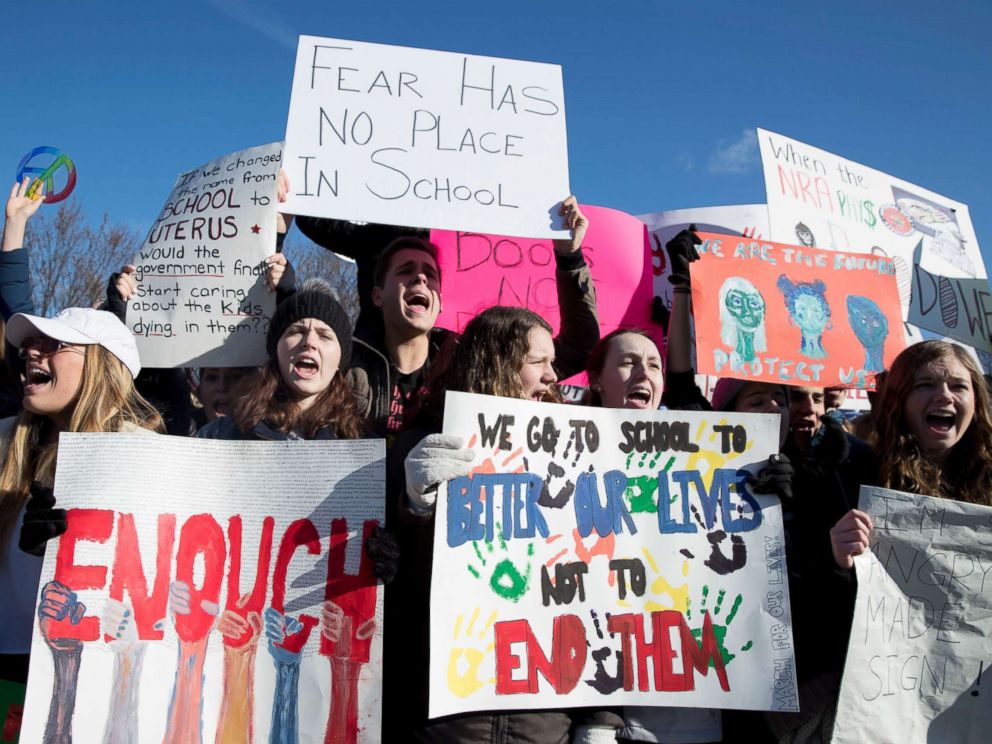
But we aren’t defined by adjectives; we are the future. In just a few years, most of us will be given the power to vote, and we will remember when you ignored our pleas.
Photo Credit: ABC News.
You ignored our pleas for equal rights, our pleas to not feel afraid to walk into our schools, our pleas for an equal opportunity you pride your country over yet fail to fulfill.
We will remember what you refused to give us, and we will take it ourselves.
The years will come, and the world will become ours. Not just for one percent of us, but for everyone.
A world where students can walk into their schools without the fear that they’d never walk out.
A world where people are free to love who they wish to.
A world where people are judged by their personality or by what they bring to the world. Not by the color of their skin, or their preference of who they love.
So remember this
We may be young,
But we are angry.
And you can try silence us, but we will rise, and we will scream louder than ever.
Isn’t it exhausting? Exhausting to have a standard already set for what makes a woman beautiful? Everywhere you look, you see a beautiful girl with beautiful hair, skin, and eyes, a beautiful smile and a beautiful body, a girl who looks nothing like you. She doesn’t seem to look like anyone you’ve ever met before, either, except for the hundreds of other girls you see on billboards or magazines. Those girls all look alike.
Isn’t it exhausting that from the time you are born, you are programmed to think that the basis of your worth comes from the extent of your beauty? Why is so much of your importance based on your physical appearance, when really it shouldn’t matter at all?
How long have you felt the pressures of upholding the image of a “woman”? Since as long as you’ve been able to communicate, you are told what you should and should not do or say, how to act, and even how to sit properly.
Isn’t it exhausting to feel like you’re never good enough? Isn’t it exhausting to be chastised for speaking your mind or disagreeing with someone, to feel guilty for eating a big meal? Doesn’t it frustrate you to think that you might not be paid the same amount as the man sitting in the desk next to you and who signed the same contract as you?
Do you get angry? When you have too much contact with the opposite sex- you’re flirtatious and need attention, but when you don’t engage with men- you’re a prude.
Isn’t it exhausting to always be comparing yourself to, competing with, and feeling threatened by other strong and capable women? Girls shouldn’t have to feel this way about each other; girls should want to support each other. Do you ever try so hard to make everyone else appreciate you that you forget to appreciate yourself?
Why is it okay for your brother to tell a sexual joke, but God forbid a sister should make one, for then it becomes “disappointing” and “irresponsible.” Why in third grade PE do the boys have to do twenty push-ups, but the girls can only do ten “girl” push-ups? Why do boys use the phrase “like a girl” as a way to insult one another, why should boys be warned not to “throw like a girl”?
Isn’t it exhausting to always be made so aware of how you look? To feel self conscious about even your chipped nail polish because a boy commented on it, to feel uncomfortable walking past groups of men on the street for fear of hearing how pretty you look in that little dress.
Why are skinny girls the only ones allowed to wear certain clothes, the only ones you see in advertisements? Does it make you sad to think about how strongly society correlates being thin to being beautiful?
And why is it- no matter what- everything always comes back to your physical appearance?
Being a girl myself, I think I can sum up the answer to these questions, on behalf of all girls: Yes. It does make us sad, and angry, and frustrated. It is exhausting – and we’re tired of it.
Periods. Otherwise known as menstruation. Otherwise known as the precursor to pregnancy, that time of the month, the curse, the monthlies, shark week, and the list goes on. Yet, with its many names, society seems to forget about this natural way of life. The fact that 49.6% of the world experiences this process at one time or another would make it seem that the conversation surrounding it would be frequent and healthy, but no.
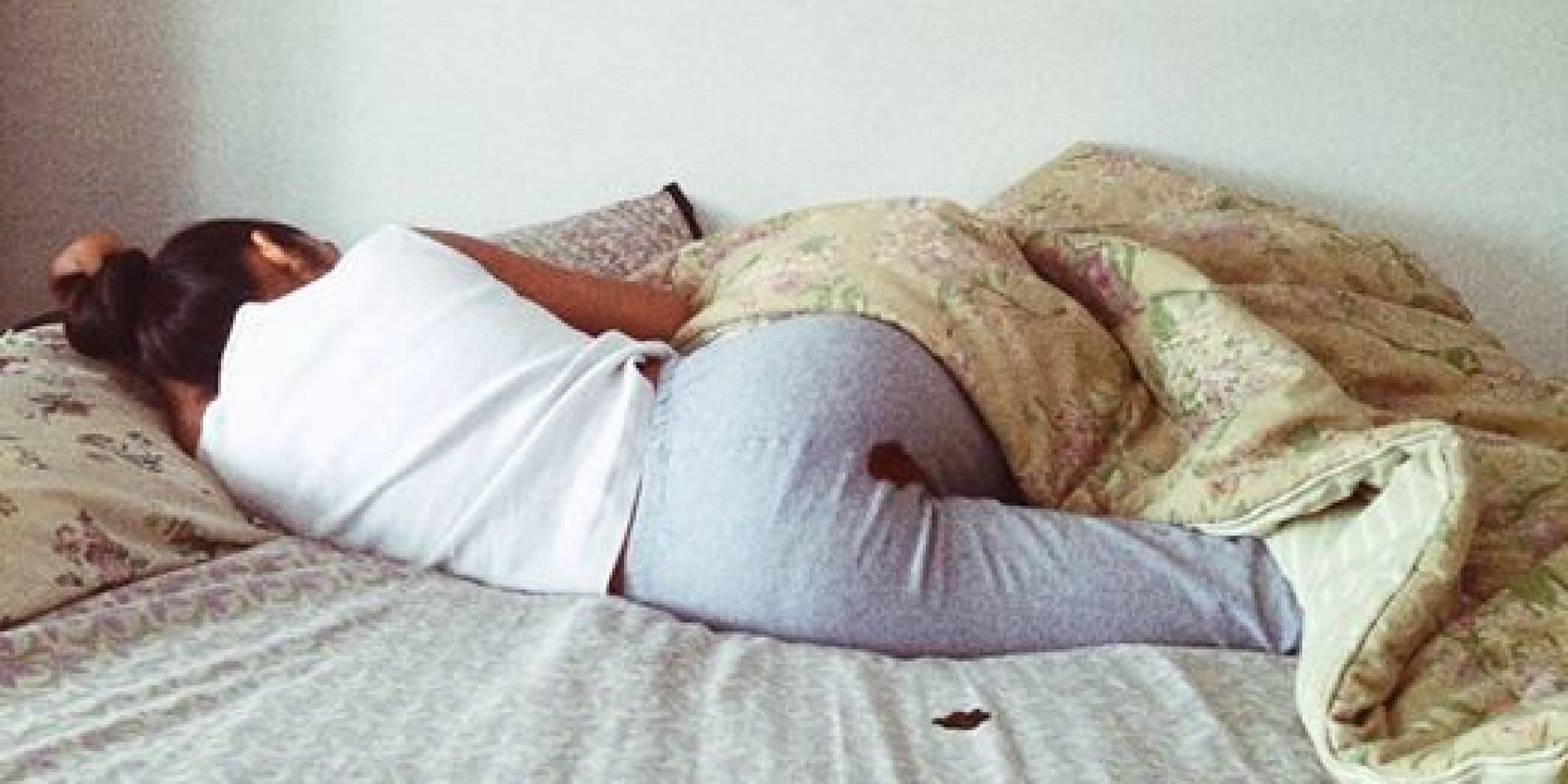
Anyone born with a uterus has heard the first period stories. I remember before I got mine, I heard about my mother’s. She hid her underwear and would sit crying in her room because she didn’t want to tell her parents that she was dying. Think about that for a moment. Albeit, sexual education has progressed since my mother was a teenager, but the lack of information about periods is still very much an issue. I don’t remember any information about periods except a movie in fifth grade titled Just Around the Corner and a brief lesson about it in freshman year. I don’t remember learning what pads to get, if tampons are right for me, how to handle cramps, how to predict/learn about my cycle, and many other questions that I still have today.
Photo Credit: huffingtonpost.com
“Most girls learn about their periods the day their periods start,” says Chandra-Mouli, a member of the World Health Orginization. He describes the all too popular story that usually goes like: “I started having periods at school. Spotting on my clothes. Giggling in class. I didn’t know what was happening. My panties felt wet. My teacher made me wait in the staff room. I thought my insides were rotting. My mother came and wrapped me in a towel, took me home, put me in a bath and said, ‘You’re a woman now. Don’t go out and play with the boys.’”
That lack of education is even worse in many other countries. Periods are seen as a curse; women are shunned from public life and aren’t allowed to cook, clean, or learn. It’s also immensely harder to get proper sanitary items and unhealthy options are almost always used. Did you know that 10% of girls in Africa miss out on school because of their period each month or that 4/5 girls in East Africa lack the access to basic sanitary supplies? Why are we letting these young, impressionable girls internalize these gross views of their bodies? In order to help the ever-growing future, we need to help young women all over the world to feel no shame about their bodies.
I think that the first step to getting rid of social stigma is education. Teach boys how to pick out period products for their sisters/mothers/ girlfriends and how to be supportive to these women in their lives. Teach kids that there are transgender kids who either do or don’t have periods and it kills them on the inside. Show us pad ads where the coverage simulation uses red ink instead of blue. Teach girls how to feel confident on their period and how to handle this intense shift in hormones. Open up this conversation in class or at meals. Yes, it may be uncomfortable, but if it could help one more person not stain their clothes or miss another class, then, in my opinion, it’s worth it.
Halloween is arguably one of the most fun holidays. You can dress up like a banana, a zombie cheerleader, or even a cat. However, a certain kind of costume that is not acceptable, comes around every year. Those costumes fall into a small category: when people adopt the aspects and features of another race or culture as a costume, a joke. Some examples of this are blackface and yellowface where people will literally paint a color onto their skin to make them look like a different race. Halloween is not the proper place to display your racial microaggressions. You may not even be aware of them, most people aren’t. Microaggressions are when you say a racial slur or dress up as another race to make fun of them. Actions like these showcase how unaware our society is to the amount of cultural appropriation we experience on a daily basis. Some may take this as it not being okay to dress up as their favorite movie character of a different race, but that is not the case. Little kids can dress up as Mulan, Pocahontas, and Tiana, because they are doing it out of admiration, not disrespect. It is hard to identify when a costume goes from okay to bad. If you think someone will be offended by your costume then odds are it isn’t appropriate.
In 2012, a group of students at Ohio State University, known as STARS (Students Teaching About Racism in Society), made a series of posters to showcase this problematic Halloween trend. It is a series of six posters each picturing an offensive costume representing a racial stereotype, an actual person representing that racial group, and the same line: “You wear the costume for one night, I wear the stigma for life.”
And this is so true. Coming from a place of privilege, I don’t understand the type of oppression people of color receive on a daily basis; neither do any of the people who dress up as stereotypes of a culture. If you dress up as a racial stereotype, then you most likely don’t know anything about that particular culture’s daily oppression. People who don blackface or dress up as a nerdy Asian never have to live in the skin of people of color. They don’t have to wake up knowing they’ll be judged for the amount of pigment in their skin. Most people dress up as stereotypical racial figures to make fun, not knowing anything about what it’s actually like to be who they’re dressed up as. On November 1st, you can wake up in your safety bubble of skin and go on with life, but the group of people you made fun of the night before will continue to wear the skin and/or identity that you appropriated as a costume.
Most people that know me can agree that I’m an outspoken feminist. They know that I stand up for women’s rights, try to be politically correct, the list goes on. They know that I love to write or that my favorite color is yellow. They know my face, the way I smile or laugh. To most people, I’m just an average teenage girl. Thank God that’s all I am. What most people don’t know is that this image could completely disappear, tarnished forever in a matter of minutes.
How?
Rape. Already I can sense one of two reactions: fear, a freezing shiver down a spine or bile pushing to the surface, or exasperation, a sigh because this post is going to be one of those posts.
When I think about sexual harassment, I think about the horrifying statistics. One in six girls will be raped in their lives. That means that out of the girls in my grade, at least three of us will get assaulted. One in 33 boys will be assaulted. That’s at least one boy in each grade. Yes, these are just statistics and all, but most of the times that’s all we think about.
Over the summer, I read Louise O’Neill’s Asking For It, a story of a girl named Emma who was gang raped by four boys. At first, Emma is portrayed as self-centered, egotistic, and promiscuous. She is mean to her friends, constantly degrading them.
Photo Credit: cornflakegirlmusings.com
It frustrated me how rude she was, but as the story went on, the rudeness was actually unmasked as something else, self-degradation. Her entire life she was called pretty, fawned on by boys and envied by girls. She was constantly making sure to cover up, but simultaneously show off. Her mother would always tell her to put on a jacket or a longer pants, while her friends surrounded her with shorter and shorter skirts. She internalized something most girls have to.
Nowadays, the Internet is filled with selfies, pool pics, and photoshoots. Sleek hair and tanned, toned legs become a requirement before sending out an image on Instagram and Facebook. Emma’s world was filled with those kinds of pictures. She went to parties just to say she did, trying to keep up this delicate image of a girl who was respectable but still had fun.
However, that image was tattered when she was raped. She showed up to the party in a too-short dress, drank dozens of tequila shots, and tried a drug a boy gave her. Common ingredients in the recipe titled: She was asking for it.
It’s interesting to think that someone could be assaulted and instantly presume it was the victims fault. Even if she was wearing nothing, her body doesn’t become something to claim, to take advantage of. It’s sad that rape becomes so black and white, either the girl did something wrong or the boy made a “childish” mistake. No one ever gets into the nitty gritty. It’s always “She was asking for it” instead of “She was raped.”
Modern society has a fear around the word rape. People want to mask what that word means, mask the disgusting feelings around it. People hide behind anonymous names, jeering at victims, trying to make it less real. If she wanted to, then how can it be bad?
Louise O’Neill and many other have taken a stab at this ever-present issue, trying to raise awareness. I condemn these brave souls, as talking about rape is so taboo. Rape is an international issue, as this book addresses, and is not just some “feminist issue.” Rapists are let out of prison within weeks, while the victims are left with a lifetime of shame and painful memories.
Rape needs to become an outrage. Homicides are treated with heightened media attention, the deceased becoming a saint in the eyes of the public. Where is that same sadness for victims of rape? Yes, they didn’t die, but a part of them was lost when they were raped. Many are left chained to a life of stolen glances and hushed conversations.
It’s hard for people to talk about rape because they’re misinformed or it simply makes them uncomfortable. Personally, I agree. I would like nothing more than to talk about the weather report or to compliment my friend’s shirt, but sometimes I’m left fearing about out of my friends and me, who’s going to get hurt next? That’s why we need to talk about rape culture. We need to make rape not okay, make rapists see the wrong in their actions, as not to encourage repeated offenses. We need to make rape as scary as being killed, so that young girls and boys can go about their lives with one less thing to worry about.
Before I begin, let me say how much I love this school. OVS has provided me with a home away from home and friends that I will cherish for the rest of my life.
That being said, this school isn’t without its flaws. So, that’s what I’m here to talk about today.
Every Monday, the dormers have to dress to the nines and sit at the usual cafeteria plastic tables, but set with tablecloths and flowers in vases. Boys dress in their nice shoes and suits, while the girls step into their heels and flowy dresses. The dining hall’s aura is changed into that of a nice restaurant, instead of its usual casual conversations and colorful plates.
But, before any girl can make it across the hill, she has to go through dress check. Basically, she is required to check her outfit with a dorm parent. While this isn’t my main point, I must say that this process is, in its root, sexist. We have to make sure that our bra straps are concealed, our dresses aren’t “too short,” and that we look like “nice, young ladies.” Girls have to follow a strict set of rules and to what avail?
We all know that we can’t show our underwear and shouldn’t be wearing jeans and a t-shirt. I apologize severely if throughout my meal my bra strap distracts a boy or teacher from finishing their mashed potatoes. I’m sorry if the skirt of my dress shows my upper thigh when I first sit down or stand up.
Photo Credit: momomod.com
I’m not saying that I want to wear a cocktail dress to dinner. I just don’t get why a low back is so offensive if we are sitting down for the entirety of the meal?
Back to my main grievance for the day, a new rule has been put in place. During dress check, if our dress doesn’t meet any certain guideline, we will be given a dress to wear. Not just any dress, though. No. We’ll have a choice from one of the many new thrift shop garments hanging up in the lounge.
The dresses aren’t simply to meet the guidelines of the meal, but to embarrass those who don’t make it through dress check the first time around. Shouldn’t the whole purpose of dress check be to make sure our dresses are appropriate? If we are showing too much skin or our bra, we are expected to change. This system is in place to make sure that doesn’t happen. Why are we now being penalized for following the rules?
We are checking to make sure we can wear our outfits to dinner. That’s the whole point of that exercise. However, this check will become a test. If our dress doesn’t fit the needs of the school, we’ll have to put on an oversized piece of obnoxious floral cloth or an outdated two piece set.
Well, I guess I’ll have to make sure not to corrupt the young minds of the boys around me! And, hey, thrifted clothes are so in!
On Friday, audiences will once again revisit the “tale as old as time” when the Beauty and the Beast makes its live action debut. The movie, featuring the amazing acting abilities of Emma Watson and other Hollywood veterans, has already been featured in many famous news platforms. Why? In an interview done by Attitude, a British magazine, the director, Bill Condon, revealed that LeFou, Gaston’s trusty sidekick, will be gay.
While he didn’t specifically say what will happen, this statement was met with many different reactions. To some members of the gay community, this was a breath of fresh air. Finally, Disney, a huge media influencer, has validated the gay community with its first “exclusively gay” moment. The fact that a character in such a beloved classic is out, or at least exploring his sexuality, is the representation that many wished they had when they were younger.
However, some members of the gay community were upset by this update. Ryan Houlihan, a Teen Vogue writer, states his ailments in the following, “They made the gay character a villain, relegated him to being a sidekick, gave this explicitly queer role to a straight actor, and then muddled the issue by making him sexually ‘confused’ – just to hedge their bets.” It’s also terrible that Lefou’s entire “gayness” is him pining over his unattainable straight friend. What the LGBT+ community needs is a gay character who gets his feelings reciprocated and a meaningful plot progression.
No matter the opinions, the media has gone into a frenzy about this new additive to the plot, making it a hot topic for new interviews of the stars. Emma Watson, the actress of the remade feminist Belle, made it quite clear that LeFou’s gay moment isn’t extremely pronounced, on the other hand, she called it “subtle.” Apparently, it’s a mystery whether he is in love with Gaston, as it isn’t written in the script.
Bill Condon thinks the attention is “overblown,” as Josh Gad’s character is featured in a background dance scene with another man. Condon’s response to this attitude surprises me. Saying that this movie will feature the first “exclusively gay moment” in Disney’s history is a pretty big deal, so being shocked by the media outburst seems a little odd.
Nevertheless, I’m excited to see this moment for myself, as I want to experience this revolutionary moment on the big screen this Friday. Watch a preview of LeFou’s famous “Gaston” here:
In an interview done by Fox News, Teen Vogue writer Lauren Duca’s authorial legitimacy was questioned. She was asked to be interviewed after writing a piece on Donald Trump back in December 2016. So, as one would assume, she thought they would ask her about the article. Instead, they went on for ten minutes about how, as a fashion writer, she was unable to accurately write about politics.
This kind of blatant sexism is found in many places in journalism and is becoming commonplace with female journalists. The fact that a respected news organization like Fox News could let an interview like that air is beyond me. This incident didn’t just spark unrest for Miss Duca, but for journalists like her. Why is it that because a woman writes about fashion, makeup, or hair, she is incapable of writing about more serious things like politics or other current events?
This false predisposition is just what Teen Vogue sought to disprove in the newest edition of their magazine. Wrapped in a tall collectible format, hundreds of ideas were displayed to their many, avid readers. From the profound significance of the Academy-Award winning movie, Moonlight, to one man’s relationship with makeup, this magazine tackles a wide variety of ideas.
After reading this volume on my flight back to Los Angeles, I was blown away by the passion some of these authors wrote with in their articles and the stereotypes of a “teen magazine” that were totally disregarded. I read interviews of celebrities, such as Troye Sivan and Lena Dunham, done by people close to them. They were laced with a feeling of comfort, something you couldn’t find with a typical interview. I learned of the uplifting story of a Syrian girl finding a new life and love after fleeing her war-stricken country. I read stories of all different kinds of love: sisterly love, pet-owner love, love of fashion, and self-love. This volume talked about consent, masturbation, sexuality, and other essential lessons not always found in the sex-ed taught in high schools. The photoshoots showed candid smiles, unique fashion, and people of all races and sexualities.
Photo Credit: thefashionspot.com
In the future, it is my hope that more magazines will follow suit. Continuing to write about fashion and makeup, but also about things that matter outside of that realm, will further enrich the knowledge of many. It is important to hear voices from many walks of life, as representation is the first step to feeling empowered.
The charming who get turned away before they can flash their brilliant smiles. The forgiving who are given nothing but punishments for the actions of others.
The aspiring doctors, teachers, or parents whose lives were cut off or thrown off course.
The eloquent whose thoughts will have to be shared in diaries instead of at universities. The confident who get put down until they would rather stare at the ground than at a mirror.
The brave – the ones who perilously fought for their country, who can’t receive their medals or see their families after a long, hard battle.
The humans who are treated like less than they are, and much less than they deserve.
This is for all those in Iran, Iraq, Syria, Yemen, Sudan, Somalia, and Libya who have faced injustice, not just from every-day Islamophobia, but blatant xenophobia from the leaders of a so-called “great” nation.
There are many online trends. Some are funny, like the Hollywood sign vandalism, while others are, frankly, destructive, like the popular “transformation” pictures.
Photo Credit: @transformationfeed
While scrolling through my phone, I came across an Instagram page called “@transformationfeed” which has nearly 1 million followers. The profile is filled with various before and after pictures. Some showed people growing older, more muscular, gaining weight, and, most popularly, becoming thinner. Each photo is flooded with comments about how inspiring these people are, how they wish they could look like him/her, or how they wish they could lose weight.
This page, and its many variants, are just another outlet for people to become obsessed with changing their physical appearance. Little girls/boys will see these photos and want to be older, because that’s the only way they’ll look attractive. Some will see the drastic weight loss and want to lose weight themselves. Obviously this desire will happen anyway, but pages like this just scream that changing ones appearance will make them “inspirational” or “lucky,” among other things.
Photo Credit: @transformationfeed
Of course, these stories are inspiring. And of course, I’m glad these people reached their goal weight, grew older, or fought cancer. However, I don’t like seeing pages that promote unrealistic expectations. These stories spark feelings of discontent, unease, and make those who can’t gain/lose weight feel even worse.
Now, it must sound like I’m complaining, but what if instead of posting before and afters, we just post afters. We just post pictures celebrating the current beauty of these individuals. We just have an account celebrating people of every size. “All bodies are good bodies,” says an article in FEMmagazine.



 OVS Journalism Blog
You must be logged in to post a comment.