This will probably be the first and last post where I’m this free-spoken, but I know this will be therapeutic. I know we all have bad days, but what do you do when the closest people to you are just gone in a matter of seconds? What do you do when suddenly that someone becomes just a memory and you realize that you can’t make any new ones with them?
As I’ve found out for myself when everything is going great, suspiciously good, the universe has to balance it out. The Bob Ross quote, “Gotta have opposites dark and light, light and dark in painting. It’s like in life. Gotta have a little sadness once in a while so you know when the good times come. I’m waiting on a good time now,” me too Bob, me too.
In moments like this, you feel like an outsider to the world and you just want to get away, distract yourself somehow. But I’ve forced myself to accept and face the facts: time heals, but you need a lot of it.
In an interesting turn of events, Ed Skrein, who was originally set to star in Hellboy, backed out of his role this summer because of his character’s mixed-Asian decent. Now, I’m upset that not enough people are talking about this. Hollywood is known for casting white actors in place for roles that are for people of color. However, Ed Skrein is the only actor, that I’ve heard of at least, that has declined a role because of this reason.
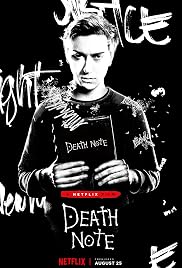
This is big news because of how rare it is. We’ve seen actors and actresses with amazing, prolific careers ignore whitewashing and accept a role that a person of color deserves. Earlier this year, Scarlett Johansson played main character Major Mira Killian, adapted from the Japanese manga series Ghost in the Shell. The movie barely saw any profit, less than 70 million made in its entire box office career. Matt Damon starred in the Great Wall, a movie literally about a white man leading a gigantic Chinese army against monsters attacking the grand fortress. Most recently, Netflix released Death Note, starring Nat Wolff, another adaptation of a popular Japanese manga.
Talking about Death Note for a moment, back in 2015, when Nat Wolff was announced as the film’s lead, Light, there were obviously mixed responses. One came from up and coming actor, Edward Zo, who was denied the opportunity to even audition for the same role. Why? Because he was “too Asian.” Here is his story below:
Something he said really stuck with me. “Hey, your story is really cool. Everything about this story is awesome, except you,” he said, when explaining what whitewashing feels like. What directors are doing is taking away the authenticity of a story. You don’t see white actors playing slaves, it’s not their story to tell. Manga, a style of Japanese comics, is quintessentially Japanese. Not white. What you get are stories that stay with Japanese adults and kids alike. Why take that essential part away in the movie version?
Photo Credit: imdb.com
What I just talked about are just actors stealing roles from Asian, more specifically Japanese, actors. I could show hundreds of examples of Hollywood whitewashing. Some older movies even use blackface and yellowface instead of just hiring people of color. What all these movies have in common nowadays are their social media outcry based on their faulty casting. I hope that Skrein’s decision and the obvious negative effects it has on a movie’s reviews will deter Hollywood from whitewashing in the future.
It was oppressively hot, but it was worse inside. The idea for the party had been born earlier that month, straight out of the heatwave, full of desperate loneliness and braised, salted wounds. He had thought that the heat had been bad when the party was thought up but it had gotten worse, the end of summer was supposed to bring promise of a cool refreshing fall, but instead the dog days were holding on.
Partygoers were wilting like flowers, falling and rising in dance on a phantom wind born and nursed by too-expensive-booze, and sweat dampened morals, the peace was tenuous. It was just too hot for a party, even the breeze was like licks of fire on his cheeks.
The rail of the balcony scorched his forearms, but it was better than dancing in the heat. He dropped his head back and looked for stars he would not find, but before the search even truly began the click of heels sounded behind him, the echoes of a last ditch S.O.S in consistent and aggressive morse code.
He did not look, she came up to the railing next to him. He still did not look at her, but in his peripheral he could see she was reasonably tall, dressed in unseasonal black, sleek. She inclined her head and stared out into the darkened hedge maze below them, all shadow. He could sense her grace rather than see it, there was something indescribably elegant in her presence, but she was incredibly still. She was pensive in a way that only people dressed in finery and malcontent can be.
She looked on as a couple stumbling their way through the doors below them, tipsy, glittering and very much in love made their way into the maze. Both were dressed in crisp autumn colors, one a in deep burgundy gown that splayed behind her like a trail of fire and the other in a warm burnt orange that fell like water.
Photo Credit: previously.tv via Penny Dreadful
Two leaves dancing in the too warm night, lost to the world and unregistering of the weather outside of their perfect dichotomy.
She glanced sideways up at him through the leaden air, her sharp, slanted eyes caught him off guard, caught him staring at her with the sideways glance of someone interested but unwilling to admit it, but her interest was clear.
He slid his eyes lazily away and turned so his back was to the railing. She turned her head to see his profile, if he glanced at her out of the corner of his eye again he would see almost her whole face, a dangerous temptation. He hadn’t really seen her yet, the tendons in his neck lightly pulled him to look at her, but he resisted, he vowed not to look. He didn’t want to talk to anyone, especially not at this party.
She sighed, a light huff of hot air in the even warmer atmosphere around them, the air around them weighed heavy on him, even the light seemed dragged down. She leaned her narrow gloved hands on the bannister the stem of a champagne flute nestled in her long, lithe fingers.
She was made of long lines like an artist had just drawn out the essential curves in stark black strokes, she flowed like fine ink.
She swirled the champagne in her glass, light winked off it catching the light like a star on earth.
“This is the expensive stuff and what a glass to put it in.” Her voice was low and rolling over him, lulling him into a stupor, “The cost of the wine almost justifies the dressing up, but this glass, the glass definitely justifies the dressing up.”
A sudden shattering caused his trance to break, his vow forgotten his head snapped to look at her.
From her elegant and bewitching fingers the glass had fallen, no, he realized as he looked at her small smirk in profile, the fine crystal glass had been dropped, on purpose.
A galaxy now lay on the stones beneath them, the leaves in the maze had also turned suddenly at the clear cold noise cutting through the heat, but they were once again lost to themselves within moments.
He was now staring into her eyes, unable to look away, pinned like an insect to a scientist’s board, her dark brown eyes looked almost black under shadow and tapered lids.
He spoke one word, his voice rusty and thick with the overly warm air, “Why?”
She glanced down and turned on her heel, her sharp cheekbones and nose flashed in the light of the windowed doors she was headed toward, now that he had looked at her he could not look away. Those inky outlines were nothing on the amorphous night she was truly made of.
“So you would look at me,” she walked through the doors then, the promise of a cool fall night disappearing into the light of a too hot summer party.
Most people that know me can agree that I’m an outspoken feminist. They know that I stand up for women’s rights, try to be politically correct, the list goes on. They know that I love to write or that my favorite color is yellow. They know my face, the way I smile or laugh. To most people, I’m just an average teenage girl. Thank God that’s all I am. What most people don’t know is that this image could completely disappear, tarnished forever in a matter of minutes.
How?
Rape. Already I can sense one of two reactions: fear, a freezing shiver down a spine or bile pushing to the surface, or exasperation, a sigh because this post is going to be one of those posts.
When I think about sexual harassment, I think about the horrifying statistics. One in six girls will be raped in their lives. That means that out of the girls in my grade, at least three of us will get assaulted. One in 33 boys will be assaulted. That’s at least one boy in each grade. Yes, these are just statistics and all, but most of the times that’s all we think about.
Over the summer, I read Louise O’Neill’s Asking For It, a story of a girl named Emma who was gang raped by four boys. At first, Emma is portrayed as self-centered, egotistic, and promiscuous. She is mean to her friends, constantly degrading them.
Photo Credit: cornflakegirlmusings.com
It frustrated me how rude she was, but as the story went on, the rudeness was actually unmasked as something else, self-degradation. Her entire life she was called pretty, fawned on by boys and envied by girls. She was constantly making sure to cover up, but simultaneously show off. Her mother would always tell her to put on a jacket or a longer pants, while her friends surrounded her with shorter and shorter skirts. She internalized something most girls have to.
Nowadays, the Internet is filled with selfies, pool pics, and photoshoots. Sleek hair and tanned, toned legs become a requirement before sending out an image on Instagram and Facebook. Emma’s world was filled with those kinds of pictures. She went to parties just to say she did, trying to keep up this delicate image of a girl who was respectable but still had fun.
However, that image was tattered when she was raped. She showed up to the party in a too-short dress, drank dozens of tequila shots, and tried a drug a boy gave her. Common ingredients in the recipe titled: She was asking for it.
It’s interesting to think that someone could be assaulted and instantly presume it was the victims fault. Even if she was wearing nothing, her body doesn’t become something to claim, to take advantage of. It’s sad that rape becomes so black and white, either the girl did something wrong or the boy made a “childish” mistake. No one ever gets into the nitty gritty. It’s always “She was asking for it” instead of “She was raped.”
Modern society has a fear around the word rape. People want to mask what that word means, mask the disgusting feelings around it. People hide behind anonymous names, jeering at victims, trying to make it less real. If she wanted to, then how can it be bad?
Louise O’Neill and many other have taken a stab at this ever-present issue, trying to raise awareness. I condemn these brave souls, as talking about rape is so taboo. Rape is an international issue, as this book addresses, and is not just some “feminist issue.” Rapists are let out of prison within weeks, while the victims are left with a lifetime of shame and painful memories.
Rape needs to become an outrage. Homicides are treated with heightened media attention, the deceased becoming a saint in the eyes of the public. Where is that same sadness for victims of rape? Yes, they didn’t die, but a part of them was lost when they were raped. Many are left chained to a life of stolen glances and hushed conversations.
It’s hard for people to talk about rape because they’re misinformed or it simply makes them uncomfortable. Personally, I agree. I would like nothing more than to talk about the weather report or to compliment my friend’s shirt, but sometimes I’m left fearing about out of my friends and me, who’s going to get hurt next? That’s why we need to talk about rape culture. We need to make rape not okay, make rapists see the wrong in their actions, as not to encourage repeated offenses. We need to make rape as scary as being killed, so that young girls and boys can go about their lives with one less thing to worry about.
I’m not a very good writer. I don’t have a lot of fancy words to use, I don’t have perfect grammar, not even my handwriting is very nice. Yet, I can put my heart into my writing. I can spend hours and hours with a pen and some paper, writing about memories and fears and moments of joy and sadness and nightmares and daydreams. Whether on long flights, dull car rides, lonesome nights spent sitting against my wall in a room that is barely illuminated with string lights and desk lamps (for the aesthetic, I guess), I will fill pages with ink and soul. Again, that doesn’t mean that it is good writing. Usually, I get carried away, in a manner that reminds me of snowflakes jumping around in the wind, eventually finding their way to the ground after a dance one could almost find to appear indecisive and childish.
My point is, I don’t really have a point. I usually never do, to be honest. I can’t put pretty words in a pretty book to make a pretty story. I wish I could. I can only write to give my emotions a shape, as clumpy and ugly as it may be. Oh well, this is good enough. This is going to be posts of clumpy and ugly memories and nightmares and daydreams.
i don’t get how everything i’ve built could be so fragile. just when you think your foundation’s set, an earthquake comes and shakes it. next a huge rainstorm. then a forest fire. or a tsunami. each disaster shakes the very thing you thought was solid. now my house is starting to crumble on contact. the walls a little less sturdy. the ground with a few cracks. but that’s why they call them natural disasters, because they have to happen. except they shouldn’t have to. you were a fire that didn’t naturally arise. you sparked something in me. i thought you were the soft ember in the fire-place, warming the whole house in a crisp, cold night. but you crept and crawled out, until the polished hardwood floor became singed beyond belief.
Photo Credit: chriscrespo.com
you burned everything. engulfed the second floor, filled with broken-down cribs and pictures lining the walls. you exploded in the kitchen, where everything was black and it wasn’t bad cooking. you burnt the living room, even all the memories made there, the many late nights, turned to dust. you left the backyard, full of brand-new spring blooms, dead. except it wasn’t all you. my house wasn’t fireproof. my foundation wasn’t concrete, it was loose pebbles. my walls were made of rotting wood. you barely made a scratch on my already damaged surface. so, while you sleep in your warm sheets in your warm bed, I’ll be shivering under my army blanket in a foreign homeless shelter, because you destroyed my only home.
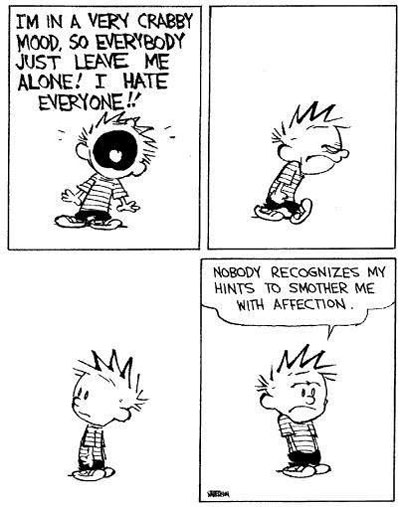
When I was in elementary school I first encountered Calvin and Hobbes. Since then it has resurfaced in various parts of my life surprisingly more and more topically.
Bill Watterson’s perennial comic often addresses the problems and anxieties of growing up, the pain of reality, and everything in between.
Watterson manages to cleverly address issues that still persist today through the eyes of the constantly adventurous and surprisingly observant six-year-old boy.
To this day, I find myself enjoying the comics in spare moments, pulling out weather-beaten copies with broken binding hoping to find a laugh or something to prove that I’m not just panicking, that growing up is indeed hard.
Watterson manages to perfectly characterize the angsty feelings of growing up and having to face oncoming reality, and sometimes it just makes me laugh and feel happy despite the panic I feel about having to continue to grow into adulthood.
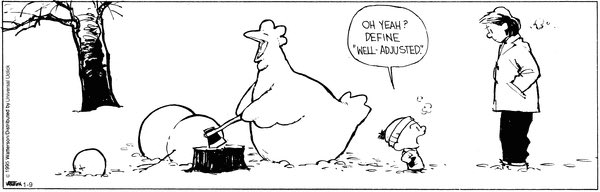
But my personal favorite remains the very last panel Watterson ever drew for Calvin and Hobbes:
we let people change us. from the moment we are born, our lives have a certain path dictated by others, whether you’re premature and in need of immediate surgery or cozily wrapped in a pink or blue blanket. after you go home from the cold hospital, you were placed in a crib and kissed on the head. the people
Photo Credit: wird.com.ua
who brought you home soon tell you what to wear and how to act. this is only reinforced when your teacher tells you to raise your hand and to ask politely to use the restroom. after you outgrow the brightly colored chairs at kindergarten table to a desk at a high school, you start letting your peers decide certain parts of you. they decide where you sit at lunch and who your biology partner is.
and after that you start letting one person decide. this person is commonly known as a spouse, partner, or significant other. you share deep night conversations filled with painful memories or happy ones. what they do with this information is up to them, and you’re allowing them to decide that for themselves. so, what if they pull the trigger, let go of your darkness over dinner cocktails or lunch sandwiches. so what if your leg got bruised when i pushed you around, sweetie? don’t worry, i’m sure a haircut will cover up that broken jaw or that black eye. when you go home, make sure to wear a little more makeup there so your mom won’t notice. you listen to them, curl your hair that way or stop hanging out with that friend.
no wonder 25% of women and one in seven men will be victims of domestic abuse. if you’re shocked, don’t be. we train people from birth how to change for others, but some don’t learn to change for themselves.











 OVS Journalism Blog
You must be logged in to post a comment.