I always go to the movies purely for entertainment. I’ve never gone to a movie where I’ve left inspired about my future.
But after watching On the Basis of Sex on Saturday, I couldn’t wait to be a lawyer.
The movie was based off the life of Ruth Bader Ginsberg. She was the top of her class at both Harvard’s and Columbia’s law schools, but she wasn’t allowed to practice law in New York City solely on the basis that she was a woman during this time.
The story followed her through her first case following a male who wanted a care giver tax deduction, but the law stated that only women or widowed men could be care givers.
This case was the spark that started a series of changes in laws contributing to giving women their rights, many cases won by RBG herself.
Photo Credit: Rottentomatoes.com
Ginsberg went from a lawyer fighting sex-based discrimination against people who wouldn’t listen to being a Supreme Court justice with a 96-3 vote from Congress.
If that’s not inspirational for a young female and aspiring lawyer, then I don’t know what is.
Ever since I was a kid, I knew I wanted to be a lawyer. I would make up cases and make my family act as the other lawyers and defendants. I went to a mock trial program at UCLA over the summer and most of my daydreams lately have been about excelling in law school.
I’m pretty sure I’m more excited for law school than I am for college.
Watching that movie made me excited for my future, excited to live in NYC, and excited practice law and work on influential cases.
So, thank you RBG. I hope to follow in your footsteps on the path you’ve helped create.
Over spring break, I had the opportunity to see The Book of Mormon live in New York City. To put it simply, the whole musical was pure genius. The whole show was hilarious, the choreography incredible, and the singing even more so.
However, despite how much I loved the show, I’m surprised that it’s even still on Broadway. I could easily say it’s one of the most controversial shows to exist, yet somehow, it’s not that controversial. In fact, according to some people I’ve talked to, Kinky Boots is more controversial simply because of the cross dressing, completely ignoring the fact that the Book of Mormon was offensive to just about every race, religion, and sexuality.
I could tell that the whole musical is basically satirical to the Mormon Religion, but in the progressive society we live in, I’m still trying to ponder how the Book of Mormon has not been shut down by Twitter and Instagram activists alike. Either people don’t watch Broadway shows enough, or it isn’t seen as a problem, even though one Tweet intended to be a joke could be interpreted wrong and ruin someone’s life.
Now, I’m going to dive into an overly, probably unnecessary, analysis of the whole musical and the music included.
For those who haven’t seen the musical yet, it follows the story of two young Mormons who travel to Uganda to convert the people there to the Mormon religion. The musical basically mocks the Mormon religion, but also uses offensive stereotypes of other races and sexualities to get their point across.
This whole analysis isn’t me criticizing the musical. In fact, it was probably one of the best musicals I’ve ever seen besides Hamilton or Aladdin, but I’m just genuinely trying to figure out how this musical hasn’t caused more controversy.
But then I realized the answer, and it’s because the entirety of the show is mocking the extremities of the Mormon faith and being entirely satirical of it. Maybe everyone who’s seen it and every critic who’s analyzed it has realized that that is the whole purpose of the show, and everyone who buys a ticket is ready to either be offended or be entertained on a whole new level.
First, let’s talk about the song “Hasa Diga Eebowa,” a song the citizens of Uganda sing when the two Mormons travel to the town for the first time.
To translate just the song title, it’s saying “F**K You God,” and that alone should’ve caused uproar to some of the people watching it, however it ended up just causing the whole audience to burst into laughter.
But the reason is that there were these people in Uganda suffering from hunger, a corrupt government, and many other issues (not to forget all the stereotypes of third world countries in Africa they mentioned), and there were these two guys trying to sugarcoat their troubles and convert them to their religion. That was saying that all their problems would go away if they followed the word of the book. Maybe that’s a flaw of all religions alike, that problems won’t just go away with a little bit of optimism. The song was criticizing that idea, but in a way that made it capturing and hilarious.
Photo Credit: popejoypresents.com
Next song, is “Turn It Off” which was basically a song about a little trick they had to turn off their emotions or “bad” thoughts, one of these, including homosexuality. Now that’s homophobic isn’t it? Was that the intention of the writers, or was it, yet again, being satirical about the faith? Were they criticizing the fact that the religion that preached to be good, was being bad to people who didn’t fit their standards? They weren’t necessarily being homophobic, but they were using examples of homophobia to shine light on the issues that came with the faith.
Next, was “Spooky Mormon Hell Dream” which was my favorite song in the whole show. Basically, Elder Price broke rule seventy-two and was now having a nightmare where he was sent into Hell for eternity. There’s the fact that he was in Hell with Hitler, Genghis Khan, and Jeffrey Dahmer, but he thought he was the most evil of them all. Now, that’s being critical of the ridiculous expectations of Mormons and rules they have to follow. The fact that one little bad act was sinful, and left them believing that they were sinful at the same level as some of the most evil people in history, that’s ridiculous. Now, this example in the show is definitely hyperbole, but it’s still a real problem addressed even if it’s to a much lesser extreme.
Those are just a few examples, but how is this show that’s so insulting still so widely accepted as only comical?
Maybe it’s because it’s so hilarious that people don’t really care, or maybe it’s the fact that it’s a musical meant to be mocking and not actually real life, but isn’t the point of the show to mock the actualities of the religion’s extremities?
I don’t know the definite answer, I’m still trying to figure it out, but for now I’ll keep listening to the songs and continue to analyze this show one too many times.
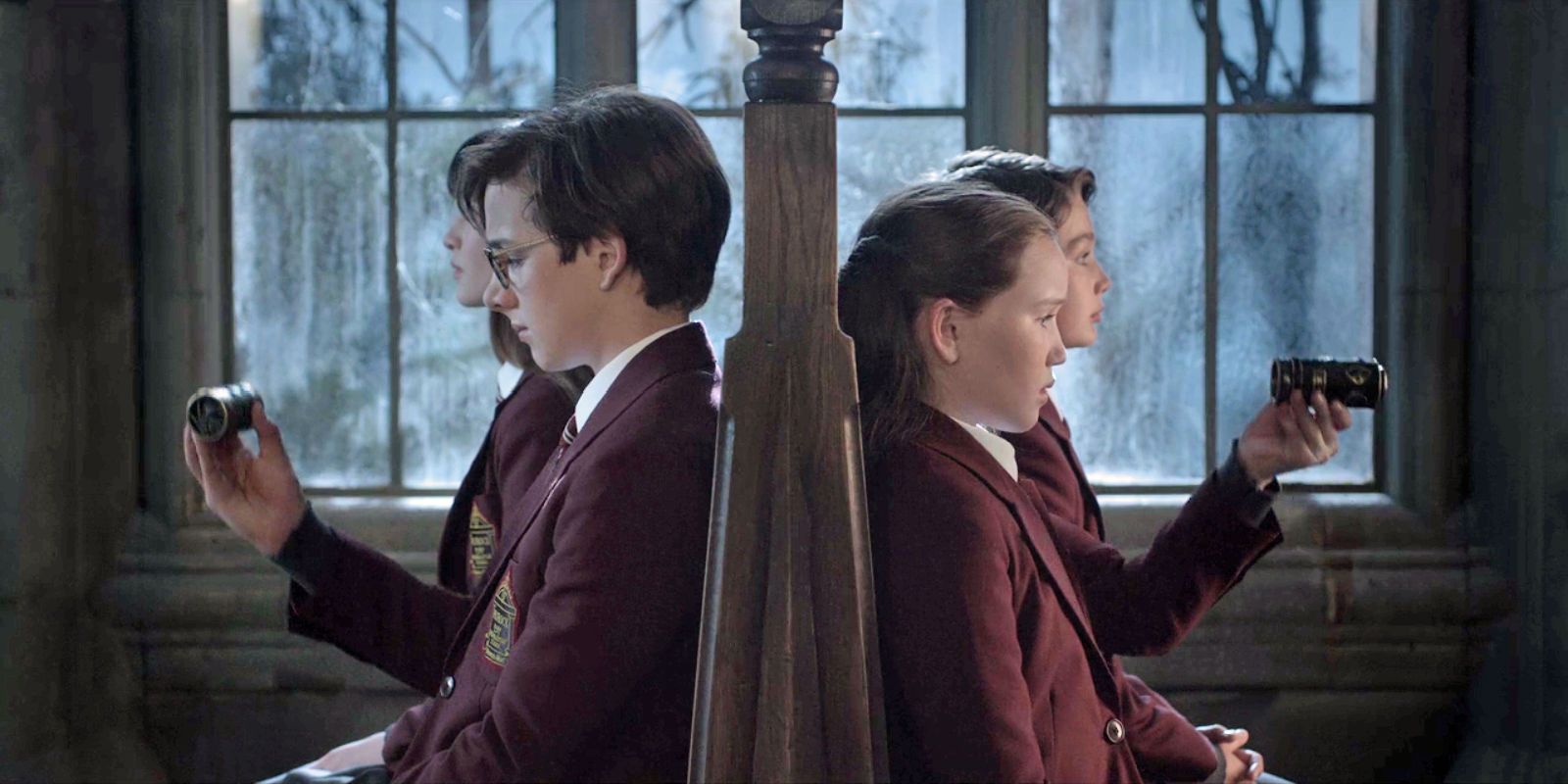
Just this past Friday, March 30, A Series of Unfortunate Events season two arrived with gusto. Streaming on titan platform Netflix, season two has expanded from eight episodes to ten and takes the views up through book nine.
Photo Credit: variety.com
This season sees the introduction of the two remaining Quagmire triplets, a swagger filled Nathan Fillion stepping into the role of Jacques Snicket, and a wonderful, fourth wall breaking, sense of self awareness that shows of this nature often lack.
While yes it does follow a predictable plot line, which was a problem many had with the first season: bad guardian –> something terrible –> Baudelaires escape. The beauty of this repetitive and predictable plot line though is it allows actors like Neil Patrick Harris (Count Olaf) and Nathan Fillon (Jacques Snicket) to really work their roles and have fun doing so, which is reflected as fully realized and sharp characters.
Photo Credit: syfy.com
The plot, instead of taking front and center like most shows/movies, takes a backseat to an incredibly immersive and rich world. Instead of trying to turn darkly fantastical source material into highly approachable comic realism (e.g. Marvel Comics), the plot champions a wonderful sort of self-realized, almost escapist fantasy that is unafraid to hit viewers in the face with a strong message of: This is our world, not yours.
With this world also comes the introduction of the highly secretive and, thus far, very vague secret society of VFD as the Baudelaires chase after red herring after red herring (ha).
Photo Credit: screenrant.com
This season is wonderful and keeps the Baudelaires on the move, it maintains the spirit of the books and the first season with dexterity, and manages newly introduced plot lines with ease. I recommend this show so highly it and I are probably in space. Go watch it.
Now I may be a bit biased by the fact that I get to see one of my all time favorite series on screen, if one is in the mood for a more comprehensive look at season two (spoiler warning) there is one here.
A couple of days ago it was announced that the release date for the live action Mulan was pushed back yet again to Spring of 2020.
Photo Credit: weibo.com
Meanwhile other movies have been pushed up and newly announced, now I can’t say what is going on behind the scenes at Disney or what is going on with any part of the Mulan-in-the-making, however I can say that from where I’m sitting I’m angry.
I’m not angry at production, corporate, actors, etc. I am a general type of angry that I will have to wait two more years to see my favorite Disney “princess” back on the big screen (admittedly, I watch the cartoon version almost monthly {life is stressful}).
Photo Credit: ew.com
Why, Disney, why? I understand the importance of Avengers: Infinity War but I want to see an Asian-woman-led movie. Which I will get courtesy of Constance Wu in Crazy Rich Asians (GO CONSTANCE!), but it’s not Mulan.
My heart hurts and child-me feels a little bit like I was offered matcha ice cream only to find out it was a heaping scoop of wasabi, but oh well. I guess I’ll have to wait two more years to see Liu Yifei (who I will, until further notice, imagine is me) kicking some major Hun a*s and saving China.
In January, I got the chance to miss three days of school and head up to Vancouver to watch the production of my favorite tv show,The 100. Now I probably know what a lot of people were thinking: this girl went on vacation to meet Bob Morley? Actually, yes, but while I did get to meet my favorite actors, eat sixty five dollar filet mignon, and find out so many spoilers for the show – and no, I’m not sharing – I also learned so much about the filming industry that I didn’t know before.
A one minute scene that seems so well put together takes hours to be made. Literally, one small scene, and it won’t even be the entirety of it. I went to the outside set for one day, and they filmed the same scene for hours, and when I left they were still filming the same scene. It was absolutely fascinating how they did it. They filmed from every angle with multiple cameras. They’d have the same actor repeat the same line a hundred times just to capture a different detail of their face from a different angle from multiple cameras.
The CW has the weirdest rules. For starters, actors could say any cuss word known to mankind, but they aren’t allowed to say the Lord’s name in vein. Also, actors aren’t allowed to show side boob in the shows. At all. So, basically the dresses lots of actresses wear at movie premiers would not be allowed on any of the tv shows from The CW we know and love.
They usually don’t rehearse. Apparently they get their lines, have fifteen minutes of their own time to figure it out, and then get in front of a camera. That’s a part of the reason why there are so many bloopers, and so many retakes of several scenes. Their rehearsal is the filming.
The camera makes people look bigger than they actually are. Not fatter, just bigger. When I met the actors, they were so much smaller than I expected, because they were a fourth of the size of what they look like on screen. They weren’t short or tall specifically, just tiny. It was definitely not what I expected.
I’m pretty sure that I learned a lot more things from that trip that I couldn’t have ever learned inside of a classroom, but that’s what I remember off the top of my head.
Last year Liu Yifei was cast as Mulan, Kelly Marie Tran became the first Asian American lead in a Star Wars movie, Bangtan Sonyeondan – better known as BTS – became the very first K-artist, besides PSY, to ever win a Billboard Music Award and the first K-group to ever perform at the American Music Awards and Dick Clark’s New Year’s Rockin’ Eve. BTS also continue to break their own records in the Billboard standings and seem to only be growing in popularity.
Photo Credit: billboard.com
Only a month into 2018 Asian representation is looking up and just a couple of days ago BTS again made history as the first K-group and second K-artist ever to earn a RIAA Gold CertificationRIAA Gold Certification for their remix of their son “Mic Drop” with Japanese American DJ Steve Aoki and rapper Desiigner; and just today (February 4) Chinese Canadian singer Kris Wu became the first Chinese Artist to ever preform at the Superbowl Half-Time Show.
Photo Credit: nerdist.com
These examples are just a couple of the milestones that have been met in just a short amount of time. Hopefully these two events this year, and several from late last year, are indicative of how the rest of this year, and the future, will go on the Asian/ East Asian Representation front.
Please stop making shows/ movies about mental illness willy-nilly. Coming from a girl with clinical depression and anxiety, your depictions never get it right. I’m a sucker for any entertainment, especially your notoriously binge-worthy shows, but your new affinity for “starting a conversation” and “bringing awareness” to such prominent issues is doing more harm than good.
Photo Credit: hollywoodreporter.com
First, let’s start with the insanely popular 13 Reasons Why, which follows the events that “led up” to junior Hannah Baker’s suicide. Back in May, when I watched the show, I felt disgust whenever it was brought up. I had watched it because I was so excited to see how a major platform, like Netflix, could start a trend of accurate representation of mental illness in the media. To my dismay, this show became another failure. I wrote a lot about this show in a previous blogpost, but I have a few things I forgot to mention. Besides being extremely triggering for those with suicidal ideations and/or depression, the show’s creators forgot to think about the very real consequences of putting out what they did. In the two weeks following the show’s release, searches relating to suicide, such as “how to commit suicide” or “how to kill yourself,” went up over 19%. To put it into different numbers, about 1.5 million more searches were made relating to suicide. Yes, these statistics aren’t exactly the show’s fault, but such a dramatic spike had to have some catalyst. Also, many teenagers and adults started performing “copycat” suicides or suicides that resembled that of Hannah Baker’s. For example, a 23 year old man committed suicide and left behind 13 audio recordings assigning blame to people he knew for their part in his suicide. You can’t possibly tell me that he didn’t have any persuasion from either the book or TV show. Since the show did not follow guidelines from the World Health Association, a very reputable expert of health in my opinion, on how to portray suicide in a healthy, non-triggering way, many people have faced grave fates on the creators’ behalves.
Moving on, Netflix most recently released a show, Atypical, about a senior in high school with autism. I, again, watched the entire season, very quickly I might add. Sam, the main character, navigates the new world of dating, which involves getting his first girlfriend. He and his girlfriend, Paige, have a sweet relationship, but it all ends when he admits his love for his therapist, Julia, in front of her entire family. Writer Matthew Rozsa writes about how grotesque this specific incident is, among the many others of show. “These aren’t classic signs of autism — they’re violent, creepy, cruel and make the autistic character seem like a monster. When the show then shifts gears to make us feel sorry for Sam, the characterization becomes more offensive. Arguing that those with neurological conditions shouldn’t be held accountable for hurting others is as patronizing as it is socially irresponsible,” he said. Sam even says that autistic people don’t lack empathy, which is very true even though many on the spectrum can’t physically or verbally express it, but some of his actions contradict that. The Olive Garden scene is an example of it, Sam, being as high functioning as he is, couldn’t realistically not see his wrongdoings, as shown by his overall awareness throughout other parts of the show.
Photo Credit: collider.com
The show also follows the lives of Sam’s family and how they have to accommodate him. This is one of the only things that is represented fairly and realistically, as an autism diagnosis doesn’t mean that loving, sarcastic, silly dynamics of family go away. However, this notion that autism is an issue that affects everything about a family’s dynamics is very harmful. Although I don’t have anyone in my family with autism or personally have autism myself, I know that living with this disability is tough. Not only is it hard to function in the world, the stigma that comes along with it is also extremely hard. That’s something this show forgets about. In trying to make an accurate representation of autism, the creators forget to get to the true depths of the disability. While writing this post, I had a long conversation with one of my friends about the show. While she doesn’t have autism herself, some of her family does. What the show misses is the fact that autism has a huge toll on the families it affects, but also the person. Actor Mickey Rowe tells of the gross misrepresentation of this notion. “Sam is a high school senior at a regular school, and he doesn’t use an assistant or paraeducator, so he’s largely independent. Yet his parents seem to hint that they haven’t been able to go on a date since he was born, implying that they’ve sacrificed their own lives to help him through his. What’s more, they talk about Sam as if they don’t have anything in common with him and at times appear to present their son’s autism as a tragedy,” he said. The show lacks the rough toll autism has on the individual, even though there are plenty of first-person accounts they could’ve included in it.
The show claims Sam is high-functioning, but his symptoms are all over the place. In a series of interviews with autistic viewers of Atypical done by The Mighty, Lamar Hardwick, who is on the spectrum himself, explains this perfectly. “There were parts of the episode where I felt some autistic traits Gilchrist [Sam’s actor] displayed were a bit too overstated. While the actor did a pretty good job overall, issues such as lack of eye contact and taking things literally started to feel like a caricature of autism. I’m not sure that an autistic person would always see themselves in that light,” he said. Although the show means well, it makes autism into an anecdote, focusing on common symptoms, to provide a goofy portrayal of Sam’s autism.
You’re left with a character who is kind of a jerk and has an overly-dramatic version of what autism really is. It’s even worse when you see how his family’s characters are much more developed and multi-faceted than his. Possibly the biggest fluke in this show is that none of the creators have autism or a family member with it. Instead, the screenwriter and executive producer, Robia Rashid, “had to do a lot of research.” Research doesn’t always lead to accurate findings, though. Sadly, this show missed the mark about how real autism really is.
Photo Credit: ew.com
Now, I may be coming off as extremely negative, but there is one show (well, movie actually) that I wanted to finish my letter with. That would be To The Bone. Again, this movie doesn’t get the eating disorder Anorexia Nervosa 100% correct. The main character, played by Lily Collins, is a young, privileged, white, and skinny girl who has divorced parents and extreme family issues. This movie had the opportunity to showcase a fat, unprivileged grown man or a person of color with the same disease to show that it doesn’t just affect those that look like Ellen, Lily Collin’s character. As far as eating disorders go, anorexia is very prominent in the media. There are so many movies and books talking about this disease. What I liked about this movie, especially compared to 13 Reasons Why and Atypical, is that the director and the main actress both have had anorexia. An article from Variety magazine describes Marti Noxon’s, the director, accurate portrayal of the disease as, “ [not an] especially pleasant movie to watch, but it is one that just might save a few lives.” What you get when you watch To The Bone isn’t some linear progression to recovery, but an extremely up-and-down diegesis that ultimately shows that recovery, something that is desperately needed when dealing with an eating disorder, is worth it in the end.
One thing I like to mention before I finish, can you tell me one thing these characters have in common? I hinted at it in the last paragraph. Still guessing? They’re all white! Not only is the media containing a complete lack of representation of mental illness, gender, sexuality, and people of color, but you never see a culmination between any of these themes. GLAAD does a very well-rounded data analysis of misrepresentation in media overall and I recommend you check it out. Netflix had a wonderful opportunity to create shows with directors and actors with these disabilites/diseases. They have all different kinds of actors willing to be a part of any media they create and while I applaud Netflix for their overall diversity, they still missed the mark when it came to these shows. The only people of color I remember in these shows are Ross Butler’s character in 13 Reasons Why and a fellow member in Ellen’s inpatient facility who happens to be black. The representation of these characters would’ve done way better in terms of conversation if they changed the way society traditionally sees these challenges. Make Hannah Baker a lesbian, Asian girl who has unforgiving parents. Make Sam black and underprivileged, not having the ability to hug his older sister. Make Ellen/ Eli an adopted, obese girl whose family couldn’t see her illness because they weren’t educated. Create new conversation by adding in REPRESENTATION. Youtuber Annie Elainey puts this into perspective perfectly.
I finish with a plead. While these movies and shows are indeed raising awareness, they have to deal with their subject matter delicately. Mental illnesses, eating disorders, and other disabilities affect too many people to be taken so lightly. What all these people need is a positive, accurate depiction of their lives. They don’t need uneducated producers and directors making stories that they can’t connect with. I love that Netflix is trying to help, but I suggest, like what To The Bone did, that the creators of these shows know what their subject matter is like. Research and conversations don’t even compare to those living with it. No amount of paper can match the grief of another hospital visit. In order to create something with truth, real experiences need to be showcased.






 OVS Journalism Blog
You must be logged in to post a comment.