AP Lit.

Photo Credit: Google

I’m not sure why I chose to take AP Literature and Composition. Yes, I do like English, but not enough to torture myself. Yes, it’s just the beginning of the class, but I’m not meant for the timed writing lifestyle. It gives me too much anxiety and makes it hard to focus on the task and hand. I’m not going to sit here and lie, but I thought I would be doing better. I currently have a grade in the B range, which I’m usually ok with, but recently B’s have been looking awful to me. 
I should have had this mindset in my Junior year. If I had, I would have had higher hopes of getting accepted into better colleges.


I digress. Every time we do timed writing in class, I always end up reading the prompt way too many times, and even then, I might still not fully grasp what’s needed. 

When I get to the writing segment, I often find myself forgetting what I was thinking about and having to go back and read through it.  By the time I’ve gotten started and have set a rhythm, I have like 5 minutes left. Once I hear “you guys have five more minutes,” the rhythm I had disappears into thin air, and I’m trying to type whatever comes to my head, but yet again, my brain has nothing to write. 

‘The Things They Carried’ Essay Pt. 1

I wish I had the time to write something good but I am in a rush. Here’s part of an essay from earlier this year in English class:

  1. What servicemen chose to carry revealed who they were. Select 3 of the characters. Explain what each carried and what was revealed about that character.

The Things They Carried is Tim O’Brian’s semi-fictionalized account of his time spent fighting in the Vietnam War. Told in a series of short memoirs, the author jumps from character to character, a story to story, in order to explore a range of themes: from death and ethics, to love and the relationship between truth and fiction. In Chapter I, O’Brien describes the physical items each soldier chooses to carry during their march. With this, the reader gets a sense of the characters, their emotional baggage, and their coping mechanisms; all of which are expanded on throughout the novel.

In just the first few pages of the book, the platoon leader is introduced through his chosen supplies. Jimmy Cross, simply referred to as Lieutenant, carries with him correspondence from a girl named Martha, who lives back home in Ohio. “In the late afternoon, after a day’s march, he would… unwrap the letters, hold them with the tips of his fingers, and spend the last hour of light pretending.” Among these letters are also two photographs and an oval pebble collected from the Jersey shoreline and gifted to him for good luck. The Lieutenant’s memorabilia expresses that he is lovestruck, and wishful and turns to his imagination in order to escape his dire reality. In fact, Cross will one day be so absorbed in his fantasies that when a fellow troop, Lavender, is shot on his watch, he blames himself and burns the letters. Because, while he may be a romantic, the Lieutenant also has a great sense of duty. As the unit commander, “Jimmy Cross carried a compass, maps, code books…and the responsibility for the lives of his men.” Altogether, the Lieutenant’s possessions reveal his sentimental and dutiful true nature – two qualities that he relies on during the intensity of warfare.

PC: https://snworksceo.imgix.net/jhn/334322c3-3260-4fc4-a9ba-1e713aea3c73.sized-1000×1000.jpg?w=1000

Essay Pt. 2

The other half of last week’s essay:

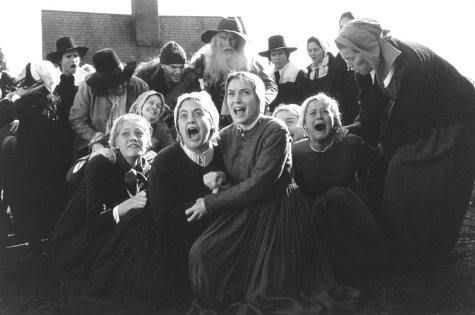
Salem, being rigidly devout, is also a town of social restraints and inhibitions. “‘There is either obedience or the church will burn like hell is burning,’” Minister Parris threatens. Novels, theater, celebration, and any ‘vain enjoyment’ are forbidden, as is the Puritan way. The narrator observes: “Evidently the time came in New England when the repressions of the order were heavier than seemed warranted by the dangers against which the order was organized.” Order is the foundation holding society together, but it also causes frustration in those who are oppressed. Abigail and the other girls, who have been inhibited by the constraints of Salem’s theocracy, are inspired to rebel by dancing and running naked in the woods. Suddenly, they are granted power that has been withheld from them previously, and the Witch Trials occur as a result.

PC: https://mdtheatreguide.com/wp-content/uploads/2019/09/The-Crucible-550×361.jpg

Lastly, and perhaps most importantly, The Crucible showcases the Puritan importance of a moral reputation. For example, when Parris suggests that Abigail’s name may be ‘soiled’, she is outraged at the prospect. “‘My name is good in the village! I will not have it said my name is soiled! Goody Proctor is a gossiping liar!’” comes her outburst. Abigail is not the only villager concerned with her reputation. Reverend Parris, himself, worries incessantly about his notoriety, as any bad word could threaten his ministry. “‘If you trafficked with spirits in the forest, I must know it now, for surely my enemies will, and they will ruin me with it,’” he frets. It is evident that a reputation devoid of sin is of utmost importance to the villagers. To preserve their own good standing, they will not hesitate to bring down others, setting the stage for the brutality that is the Witch Trials.

This stress of maintaining a ‘clean’ name, together with an emphasis on the supernatural and strict social restraints, is at the core of Salem’s Puritan society. Ultimately, it is due to these characteristics that mass hysteria is able to take root in the town and spread like wildfire. Otherworldly explanations are sought out, social restraints encourage rebellion, and the concern of a reputation pits neighbor against neighbor. Miller’s writing reveals the forces at work in Salem, Massachusetts, and their dire consequences.

Essay

I’m so tired, so here’s part of my English Essay on The Crucible:

Puritan Attitudes in The Crucible

The Crucible, by Arthur Miller, is a semi-fictionalized play based on the Salem Witch Trials of the Massachusetts Bay Colony (1692-93). Salem is Puritanical, meaning they follow a strict moral code and disapprove of pleasure and luxury. Within this culture, Miller tells the story of a lustful girl, a skeptical farmer, a corrupt minister, and a village brewing with secrets and vengeance. After a strange incident in Salem’s forested outskirts, all become embroiled in a Witch hunt that proves deadly. Through well-crafted characters and other story elements, the author manages to capture the Puritan attitude of the time period. 

PC: https://m.media-amazon.com/images/M/MV5BMjE1MDUxMjg3Nl5BMl5BanBnXkFtZTYwOTA3OTg2.V1.jpg

It is clear from the start that Salem society places an emphasis on the supernatural. Its residents see evidence of God and Satan in all aspects of life. For example, a farmer named Walcott purchases a pig from Martha Giles and blames its prompt death on otherworldly causes. “‘Now he goes to court and claims that from that day to this he cannot keep a pig alive for more than four weeks because my Martha bewitches them with her books,’” Martha’s husband explains in disbelief. Like so many other townsfolk, Walcott is unwilling to hold himself accountable for his mistakes and faults, preferring to lay the blame on witchcraft. Goody Putnam likewise finds the supernatural at the root of unfortunate events, condemning her midwives for a series of seven miscarriages. This habitual blame is wielded as a weapon, and accusations eventually lead to hangings.

Literature

As I look towards the AP English Literature Exam, I find that my favorite book can be applied to almost any prompt.

When you truly admire a work of literature, you can find obscure concepts within it. The Great Gatsby has been my favorite book to analyze and read. Once you finish a class, you can feel the literature being put behind you as you close each of the books. However, AP English Literature class has given me an opportunity to revisit old stories and use my newer skills to analyze these works further.

I look forward to using my personal collection of stories I’ve read to answer prompts on the AP exam, as it will allow me to reflect on my academic highlights from school. As I recall each story, I can remember the class conversations I’ve participated in and the numerous essays I’ve written. I hope to remember these stories into my older years and apply them to my own life.

The Great Gatsby by F. Scott Fitzgerald
Art by Francis Cugat

Sleep talking in my second Language?

I have a roommate, and she tells me that I talk in my sleep. I sometimes speak in full sentences, such as “the Jacuzzi was good,” or I mumble. When I wake up I don’t remember what I talked about at all.

Photo Credit: frontiersin.org

I’ve heard that people dream in the language they are most comfortable speaking. My roommate says I speak in both English and in Japanese. I was speaking mostly Japanese until I was 16 years old, but I’ve been using more English these past three years. I thought I was more fluent in Japanese just by the number of years I’ve used it in comparison to English, but it seems like now I know English just as well.

I was trying my best not to speak in Japanese, not to read in Japanese and not to watch Japanese T.V. shows for the past three years in order to be more fluent in English. But I never thought I would be as fluent in English as Japanese. So I am very proud of myself for achieving my goal of being bilingual.

Becoming Bilingual

When school starts back up after Christmas break, it will mark two years of living in the U.S. for me. I’m from Japan and went to a Japanese-speaking school most of my life. Since my father is an English speaker, my English listening skills were perfect when I came to America, but I couldn’t express myself verbally.

I came to the U.S. when I was 16, and I knew it was my last chance to become truly bilingual, since 16 is the age you start losing the natural ability to learn a second language. So I made a strict rule for myself: I couldn’t speak any Japanese to anyone at my school (since there are Japanese students.) It was very difficult to stop using my first language all of a sudden. When a Japanese student would start speaking to me in the language, I would ignore them. It felt awful. At first it was very difficult both emotionally and physically, but because of my strict rule, my English improved very quickly. For four months I followed this rule, until the school nurse reached out and told me to relax, and not to be so strict with myself. I took her advice and started speaking Japanese and making Japanese friends.

There was a period of time when I felt I couldn’t speak any language, since I was trying to improve my English but at the same time was losing my Japanese. After getting through that, I finally can say I can speak both Japanese and English. It was worth the struggle.

Photo Credit: i.huffpost.com

Palindrome Week

From May 10th – May 19th in 2015, the dates are the same forward and backwards, exciting mathematicians and systematic people alike. Because May is the fifth month and the year is 2015, the number 5 lines up perfectly.

See for yourself:

5/10/15

5/11/15

5/12/15

5/13/15

5/14/15

5/15/15

5/16/15

5/17/15

5/18/15

5/19/15

They’re all the same, whether you read the date forward or backward, therefore epitomizing a palindrome. A palindrome is usually used in terms of words or a phrase which is spelled the same forward or backwards. For example, “Hannah” or “racecar”.

Photo Credit: icons.iconarchive.com

A palindrome can also be a phrase, and the longest English palindromic phrase is said to have 17,259 words. It is jibberish though – for it doesn’t have to make sense, it just has to be the same forwards and backwards! The longest single palindromic word in the English language has 12 letters.

Interestingly, single letter words such as “a” or “I” are also considered to be palindromes.

This “palindrome week” phenomenon is set to happen again in June of 2016, beginning with 6/10/16.

F.I.N.A.L.S.

It is that dreaded time of year again, finals. 

After a full semester of work all I have to show for it is a bunch of pieces of crumpled papers in the bottom of my backpack and the ink my teacher puts on my test telling me how I did in their class this semester.

This time is stressful for all, and I try to not get caught up in the stress, but there is just no way around it.

Honestly, most finals for me aren’t too hard.

Math? Easy.

Science? Easy.

English? Easy

History? No sir.

Read More »

AP Week and My Mom

Sometimes, I think my mom should’ve been born my little sister. I love her to death but sometimes she can be very dogmatic.

This weekend is Mother’s Day and my mom has been meaning to come up and take me away for Saturday and bring me back on Sunday. However, the thing is the weekend that she wants to come is the weekend between the two AP weeks.

Furthermore, that weekend is a packed weekend for me. Friday, I would have just finished my APUSH exam. Saturday, I would have taken three SAT II tests. That Sunday afternoon, I would be taking a AP Biology final just to take a AP Biology exam the following day.

My mom wants to take me out to dinner and stay at a hotel with me during this hectic week, only to make it more hectic and taking time away from studying. The funny thing is, this is the first time that my mom has wanted to take me out for Mothers’s Day while I was away at boarding school. The one time that she wants to take me out is the busiest time of my academic career.

I told her I cannot do this weekend. However, she refuses to understand the pressure that is mounted on my shoulders.

Sigh.