Are We Doing Enough?

Are we doing enough?

Truly, take a moment to think about this, I’m not rushing you. I really want you to think about it.

Have you ever thought about those in other countries who carry barrels of water up to their communities that are engufled in deep or even extreme poverty?

Or have you ever thought about how some parents wake up at four in the morning, dress in their culturally traditional clothes, and walk miles, barefoot, to try and sell their country’s knick-knacks in the hot, crowded streets just to make enough to put the bare minimum amount of food in their children’s mouths?


Photo Credit: borgenproject.org


Well, on the trip that I took to Peru last week there were many of these women, these strong women, who dealt with the hardships of living in poverty, working ruthless jobs, and supporting a family most likely larger than yours.

When people think of Peru, what comes to their mind is almost definitely Machu Picchu, this is what came to my mind too, before I was able to experience what it was really like and how much I had gone my whole life without knowing.

Though the culture and history of every single city in that unique country is beyond stunning, and the intelligence of the Incans in incomprehensible, there is so much more to the country than meets the eye.

The levels of poverty in the city make Peru the third poorest country in South America, as poverty consumes up to a fifth of the country that hosts up to almost 32 million people.

Women sell handicrafts on the street, while men leave their families to work in the mines, in order to help support the ones they love. The houses are made out of makeshift materials all leaning up against each other, and the children bake in the hot sun and swim in puddles when the rainy seasons come, without even a pair of rubber boots to help them.

Though many people struggle to live like this, they are okay. They are happy. Their smiles grace their aged faces as they accept you into their community. The meaning of family extends to anyone in the community, and everyone takes care of each other.


Photo Credit: peruempireofhiddentreasures.files.wordpress.com


The happiness is far greater than that you see in the United States, with spoiled children presenting their parents with scowls signifying them not receiving the gift they had wanted.

These Peruvians live off of barely enough to get by, but they are happy, while we are here wallowing in our own pity with enough money to share.

So I ask myself, “Why are we not helping them and others in the world?” “Why are we not putting more effort into decreasing the levels of poverty throughout the world?”

I ask myself,

“Are we doing enough?”

The cutest animal

My best friend and I were skyping and talking about what we would like to be if we could be reborn. My friend said she wanted to be a jellyfish because they don’t seem to have anything to be concerned about or to be stressed! I told her that I wanted to be an alpaca; because it was the cutest animal I had ever seen.

Alpacas inhabit at high altitude of 11,500 ft to 16,000ft in South America. It looks like a small llama. They have been domesticated for thousands of years. Alpacas protect themselves from intruders by making sharp, noisy high-pitched bray sound and attack smaller predators by kicking and spitting. Most of them spit at other alpacas, but sometimes they can spit at a human too.

Diet wise, they don’t eat as much as other animals do. The intake of grass and hay, including other vegetation that they eat per day, goes up to 1-2% of their body weight. They also try to chew on almost everything,even an empty bottle.

People in Peru have been using alpaca images in their art; they also use alpaca fiber to make knits. I have an alpaca sweater, and despite of its thinness, it is very comfortable and warm.

Why are they so cute?

Altitude training in Peru

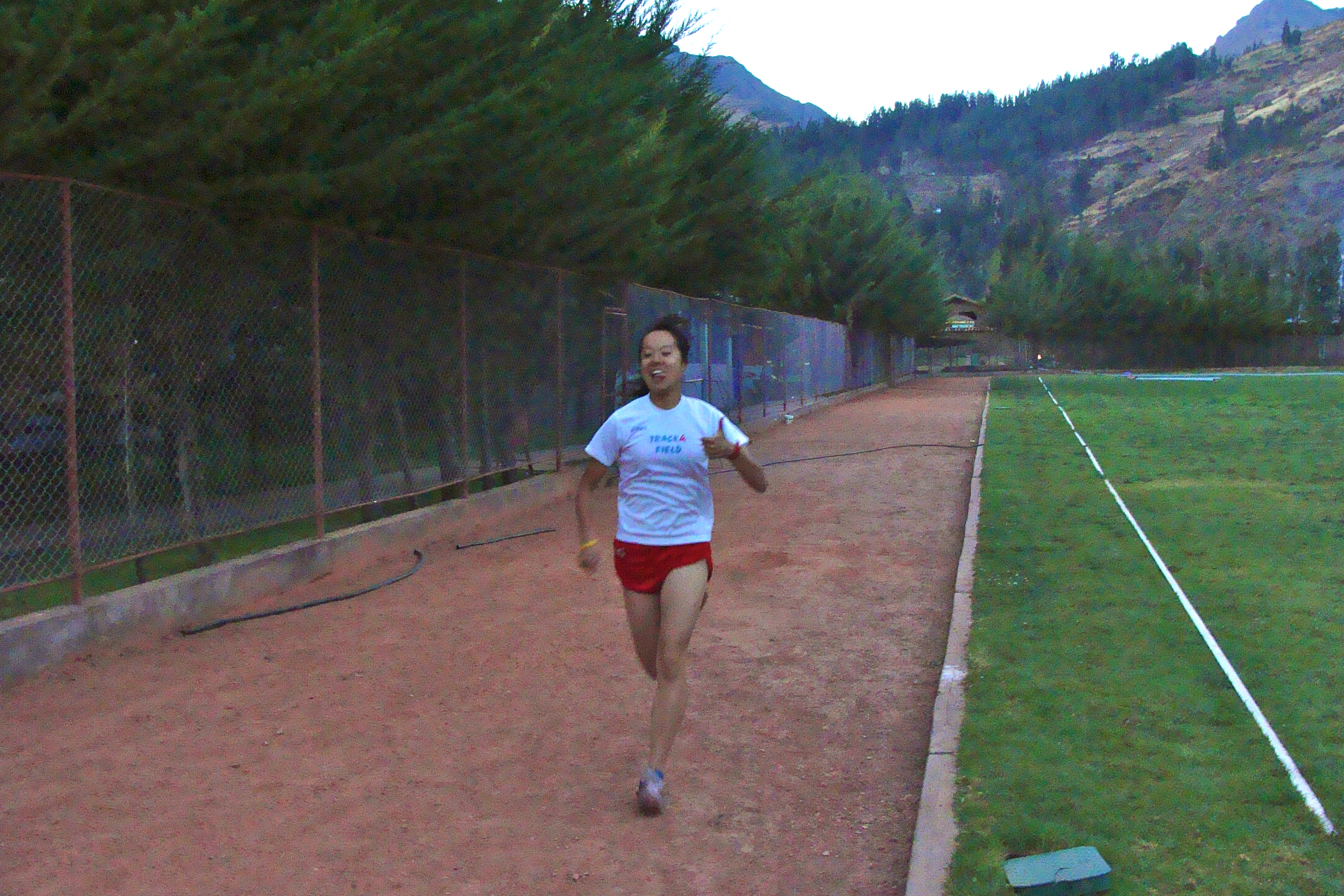
10000 ft high up, I ran hard.

The program offers an opportunity to high school runners all over the country for community service and altitude training every summer to Peru and Kenya. I was one of the lucky ones to go.

When I flew into Cusco (where I stayed for 3 weeks) from Lima (capital of Peru), as soon as the plane landed, I felt the thinness of the air. My lungs couldn’t get enough oxygen and the heart rate was so high. I thought to myself, I am going to stay here for 3 weeks… How am I going to survive? I’m at 10,000ft high. I didn’t have my oxygen inhaler, so all I could do was to get used to it.

On the first day of altitude training, we ran 30 minutes which supposed to be nice and slow, but somehow for the last mile, the pace went up to 6:30 minute mile. I was dying…

On the second week, I started to work out on track. I felt really fast, because the air is thin but the burden on my lungs killed me. My legs are moving really well but I felt like someone was pressing on my chest. I was dying… But the pain felt good after all. I really can’t wait for track season to start although its like… 5 months away.

Well, three weeks of high altitude training ended and I got back home. I went for a run on the next day, and… OH MY GOSH I felt nothing. I did a 6 mile race pace and I literally felt nothing, and wasn’t out of breath at all. It was just so amazing. BUT…it only lasted for 5 days… and those were the best 5 days of my life.

Next year, I’m planning to go to Kenya. A lot of my friends went there last year and met world record holders and world champions in running. Gosh, I can’t wait. But I also would love to go back to Peru and stay little bit longer than last time.

I want to write a lot more about Peru, but I have too much thing to say.

MUCHOOO LOVE PERU.