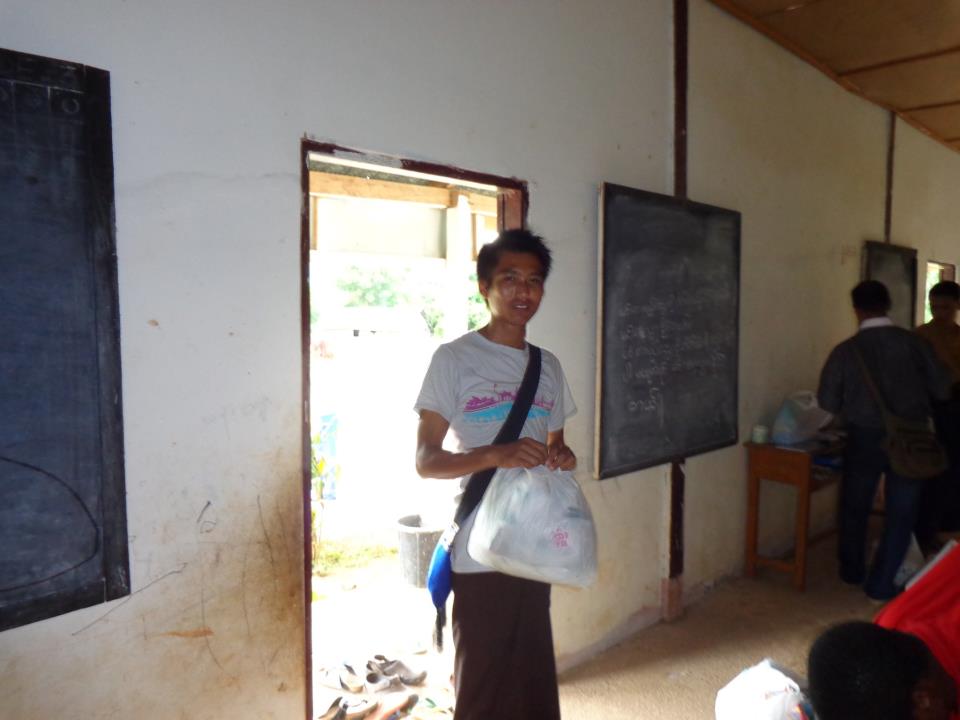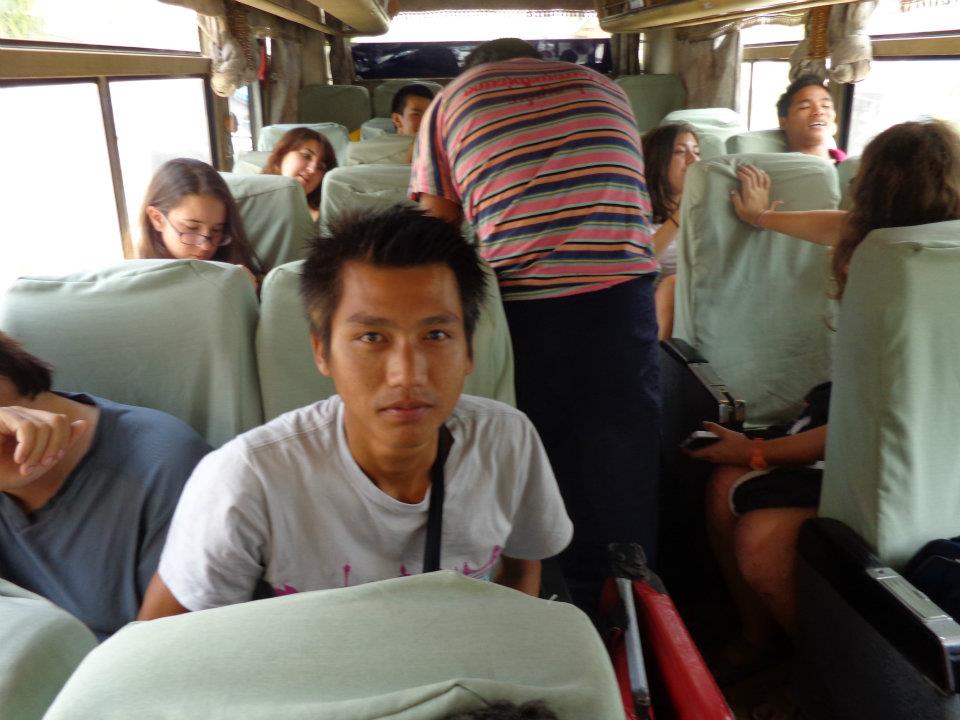
His name is Pee Sai.
He is 23-years-old.
He is my friend.
Pee Sai speaks very little English, and I speak absolutely no Burmese, but the language barrier is not detrimental towards our friendship. I don’t need to speak his language to know that Pee Sai is hilarious, kind, and worrysome. He does not need to speak my language to know how well we get along.
When I first met Pee Sai, I had just crossed the Burmese-Thai border after sitting between the two countries in horrendous heat for an hour. I was sweaty, irritated, and was suffering from one of my headaches; he was shy, not speaking to anyone as we found our way to the bus that would take us throughout Burma.

I officially met Pee Sai outside of a school in the Burmese mountains. I was asked to grab my ukulele from the bus so our group could sing a song for the schoolchildren, and Pee Sai was asked to escort me.
“Hello, I am Pee Sai, what is your name?”
“Hi, I’m Aria!”
When I tried to converse further, I realized how those few words were some of the only English words Pee Sai knew. After we discovered this hurdle, we communicated through outrageous gestures, silly faces, and universal sounds of approval, disapproval, annoyance, and happiness.

Pee Sai would seem to be, to most of anyone, a shy but friendly face; a man who has lived a relatively easy life and recognizes that.
Pee Sai has not lived such a life.
Pee Sai’s father passed away five years ago. He was very sick and was given medicine to cure the disease that it was assumed he had. He did not have that disease, and died while being rushed to the hospital to reverse the negative effects of the wrongly prescribed medication.
He says his mother is “not strong,” which means she is sick. She has to go to the hospital once a year for 15 days. Once there, she receives treatments and therapy that help with her weak and damaged back, hips, lungs, and liver. The total treatment costs his family the rough equivalence of 600 US dollars.
That is more money than Pee Sai makes in a year at his current job in a restaurant.
To pay for his mothers medical fees, Pee Sai gets loans and rents out land. By renting out his property for five years, he receives $400.
When Pee Sai works (at a restaurant, where he lives during their busy season), he gets about $30 a month. His younger sister, a teacher, receives about $10 a month, and his older sister does not generate income for his family, as she moved away to live with her husband in a different village.
“When my mother asks for money, I give it to her,” Pee Sai told us in Burmese.
His younger sister, his mother, and Pee Sai live in a two-room house made of bamboo walls and a grass roof in the village of Moo Joo Piet, Burma. There is no electricity, and no running water in the house.
Due to the loans he takes out to pay for his mothers health care, he might lose his property, too.
Pee Sai stresses and worries constantly for his mother, and has “no idea how [they] will pay for her next hospital visit.”
His mother says, “Maybe we just won’t go.”
As Pee Sai told us his story, I could see the distress and pain and sorrow on his face, I could hear the worry in his voice, I could see the redness in his eyes.
We decided we could not let our friend, my friend, suffer like this. We decided that we (fourteen highschool students and one chairman of Rustic Pathways) would pay for his mothers medical bill, as long as he continued to be good, and promised only to use the money for his mothers health.
That was when Pee Sai started to cry.
A man crying when receiving news like this would not be uncommon, except for the fact that Pee Sai is Buddhist. The Buddhists believe in total control of ones body and ones emotions, and that crying shows a loss of control. They do not cry at funerals and they are not supposed to cry at deaths, they are supposed to be in control of themselves.
But Pee Sai was so relieved, so thankful, so completely happy, that he couldn’t help but let himself cry.
It was one of the most touching and heartwarming things I have ever been privileged to be a part of.
I miss Pee Sai very deeply. I miss teaching him simple English phrases like, “Hey! Stop! Watch out!” (as he does worry about our safety quite a bit), and “thumb-war,” “arm-wrestle,” “tongue,” “skinny,” and “fat.”
I miss playfully shoving and racing each other as we walk back from dinner on a dark, Burmese street.
I just miss him.
A lot.
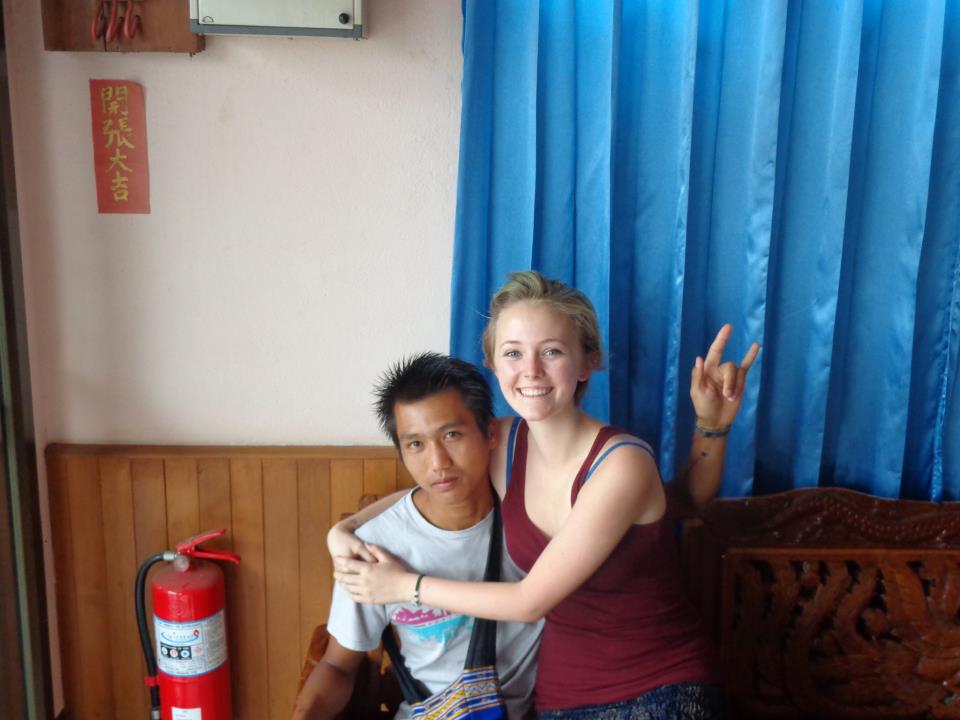
On my last day in Burma, and my last day with Pee Sai, he took my arm and a pen, and wrote out a sentence with extreme concentration and care.
Have a good journey.
I did have a good journey. And I hope Pee Sai had one, as well.
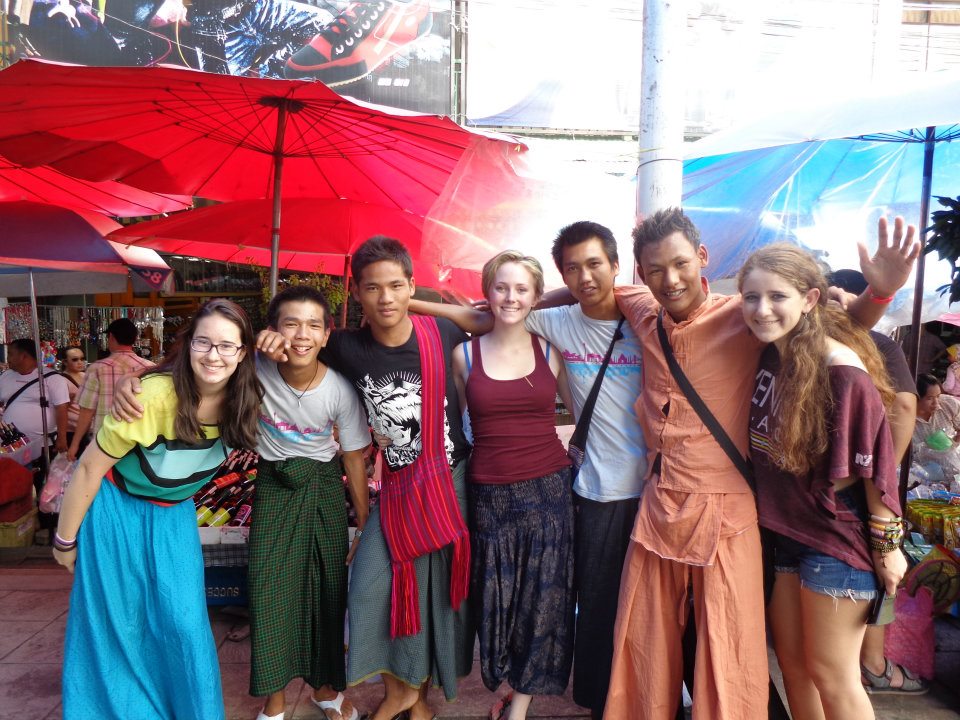
See you next July, my dear friend.
 OVS Journalism Blog