Lack of control, lack of consciousness. From a passing feeling of anxiety grows a larger, stronger sensation.
A pit embedded so deep in my stomach, sprouting vines that spread to the very tips of my fingers. The pit grows larger and larger, heavy as rock, hard as steel.
I pass it off as nothing. All in my head, nothing of significance. But this rock, this sensation, leaves me hyper aware.
Each movement shoots throughout my body, ricocheting off of every surface. Any tingle, shiver or prickle is felt in every nerve, magnified by my growing alertness.
And this greater attention leads to a realization, an understanding of this feeling. My depths are screaming to be let out, stopping at nothing to be heard.
I fall, deeper and deeper into my head; I am below the surface, unaware of the world around me. This pit, this feeling, is overtaking me.
The vines wrap around my brain, my eyes, anything they can grasp, bringing darkness to my world and shutting out any understanding.
My hands are immobile, unresponsive to my commands. These vines suffocate me, wrapping around my neck and my brain, squeezing tighter and tighter.
I have lost all ability to speak – to guide and to oversee. Dark clouds loom over my last drop of consciousness, obscuring my last speck of assurance.
Outcast – a person who has been rejected by society or a social group.
This may be the common definition and concept of what an outcast is, however, I don’t agree with it. I believe that there are many different forms of an outcast. I believe in some cases an outcast can be considered a drifter.
A drifter is someone who isn’t necessarily an outcast, separated or rejected by society but someone who is distant. Doing their own thing, while being associated with the “in” crowd but is always just on the outside. It’s like being in a group of people but always having a thin piece of glass separating the individual from the group of people.
I wonder how the people in the “in” crowd feel?
Do they too consider themselves as popular or with the “in” crowd, or do they think of themselves as drifters?
As a young girl when a boy would pick on me on the playground I was told it was just because he liked me.
As a young girl when a boy would hit me on the playground I was told it was just because he liked me.
Photo Credit: facebook.com
Where do we draw the line? If a punch leaves a bruise and a girl goes crying to a nurse, does the excuse that “he must really like you,” make the bruise diminish? Like the size of a bruise or the deepness of a cut shows fondness to a young girl.
The sad truth is that we have taught boys the idea of violence and taunting is a way to show a girl that you like her.
Society has a serious problem in the way that we define masculinity. Young boys are shown that they should hide their emotions and the only manly way to display those suppressed feelings is through violence. Because for some reason acting “feminine” is a worst case scenario.
After years of mentally preparing myself to endure the most mentally draining four-hours of my high school career, I have just completed taking a second SAT test.
I have so many thoughts about this tedious task that every high school student in the United States is required to do.
I think it is ridiculous that a standardized test score can determine a student’s future. A good student with a high GPA and a lot of extra curricular activities can get an average score solely because they might not be the best test taker, but that one test score has a large weight on which colleges accept them.
I do not fully understand why standardized tests have become a way of determining students academic careers for such a long time, or why they have become of such a high priority. Although most colleges look at students holistically, California State schools consider students purely on GPA and standardized test scores.
However, I understand the reasoning behind standardized testing; giving students a chance to show the general academic knowledge they have accumulated in high school.
But why does a test have to be the only thing that proves a student has gained knowledge? Why is it that the pressure to get a high-test score can consume a student’s conscience for months so that they focus all of their time studying for one generalized, tricky test?
Writers block is such an odd sensation. It’s like knowing what you want to write but you don’t know how to formulate it coherently.
It is literally an all-encompassing feeling of frustration and confusion.
The most frustrating part about writer’s block is that there is nothing that will make it go away except time and it can last for what feels like an eternity.
Writers block can strike at anytime, but it feels as if it is most common when there is a deadline that is fast approaching.
Breaking through the writers’ block and having the words just flow out is one of the most satisfying feelings.
It is like a dam that has been holding back a vast amount of water, and that dam finally breaking down and all the water pouring out. Once that dam has been broken down you feel almost unstoppable, like the water that just continues to flow.
When you really stop and think about it there is a time limit on everything. Homework assignments, projects, childhood, innocence, love, and even life. Most people don’t stop and think about having a limit on things that seem so long-term until they are forced to.
My godfather Leon was diagnosed with squamous cell cancer back in 2010. When I first heard he was sick I was shocked and over come with a million different emotions. I never thought that someone so kind-hearted and eternally generous would be punished with such a terrible curse.
I was in a state of denial when my parents told me he was sick. The first time I saw him after he had started treatment was heart breaking. He was so thin, so tired and so weak.
Eventually the cancer spread and he had to get surgery. The surgery that he had been on his thyroid.
All of the memories I had with him, Leon always had a beard. The first time I ever saw him without one was after his surgery. In place of his beard was a scar reaching from the left side of his throat to the right side. While that surgery scarred Leon on the outside, it seemed as if his personality and courage weren’t scarred at all.
After undergoing numerous rounds of radiation and chemo and going to doctors appointments after doctors appointments we had to accept that there is no cure.
Most people would just give up after this, saying that they have nothing else to live for, but not Leon. Throughout this terrible experience he has been the so optimistic. I have never heard him complain about his time limit.
If I could sum my godfather, Leon Azis, up into one word it would be: inspiration. To see someone who is so close to your heart go through that and not give up hope and to be so strong is unbelievably inspiring and amazing.
All I can do now is cherish the time that I have left with him and not focus on the limited amount of time, and just appreciate the time I’ve been lucky enough to have with him.
‘Just trust me,’ a phrase often used in our language, but not so often meant.
Our brains work by emotion, wired for compassion, understanding, and trust. It calms us, soothes us, and controls us. Learn more here.
So let’s start at the beginning. You are a small child, and your parent promises you ice cream. You have been exited all day, but when you finally get home, they say they are too busy for something so silly as ice cream.
You are already beginning a pattern of distrust. And you get older, friends, family, strangers, everyone you know throws around this idea of a promise as a way to calm, a short-term fix for a long-term problem.
We are often told not to make promises we can’t keep, good advice, yet seemingly impossible in our community today.
“Do you promise?’ ‘Swear on your life?’ ‘Pinky Swear?’ (Which, by the way, used to mean that if the promise was broken, he who was at fault would promptly have their pinky removed.)
Well, you say, how can we fix this? The answer is not that simple. You see, our use of human emotion as leverage has been evolving for a long time.
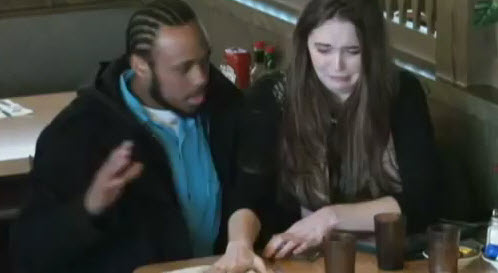
It sets up very dramatic situations, involves ordinary people in them, and watches their reactions to the dilemmas given, with the hidden cameras rolling.
It usually deals with serious social issues, and a lot of its episodes have unexpected touching results, in which people step up and take action without hesitation in order to do the right thing.
However, in this particular episode, the result surprised me in a quite different way.
It takes place at a family restaurant in Utah, where African-Americans take up only 0.05% of its population.
In this scenario, a white girl introduces her black boyfriend to her father. Unlike what she expects, the father rejects her boyfriend because of his race.
As she rushes out of the restaurant with her boyfriend, an old lady sitting next to his table talks to the father. “I am with you,” She says. “I think they should stay with their own.”
A woman behind her, nodding in agreement, is brought to tears.
“I have a daughter,” She tells her story in a shaky voice. “She has a friend that’s black… I told her, “He’s fine to be your friend, you are never going to get involved with him…” They were just friends, but… I worried about that.”
Then, the old lady adds her racist comment: “A pretty girl like her would pick something like that.”
Trying not to get emotional about her cutting comments, dying inside, the actor keeps the conversation going, asking if he is wrong.
“I was very proud of you,” The old lady responds. “Because that’s a shock to anybody.”
When the reporter of the show, John Quiñones, shows up in the restaurant, explains her about the show, and interviews her, the old lady tells us about her strong belief.
“I’m sorry,” She says. “If you are white, you are white. If you are colored, you go with colored people. And keep it in your family. Don’t put it in somebody else’s.”
She ends her comments with another incomprehensible statement: “It’s alright if you are a Mexican person, they are still white people,” She explains. “But black people and white people, no. I’m sorry, it breaks my heart.”
Finally, Quiñones introduces the man who acted a black boyfriend to the old lady. As they shake their hands, the guy asks her for a hug.
To my surprise, as she gives him a hug, she says, “You know, but I just think we should stay with our own, don’t you?”
This Episode shocked me. I thought racism was dead in America.
As an international student in California, I never considered rejecting an interracial couple as an option.
I heard of the word, “colored people,” for the first time in my life when I was studying To Kill a Mockingbird in my English class. Also, I was surprised when I learned that the setting of the story was within less than a hundred years.
Some people might think that racism no longer exists in America. However, for a lot of people, racism is still a big issue in their lives. A big chunk of generations was taught to be racist in its youth.
Now, the real question is, how should we react to this issue?
The episode ends with an interview with the African-American actor.
Quiñones asks, “She even hugged you. How did that feel?”
“Very weird, but I believe in people,” the actor answers. “I wanted her to know that, no matter what she thought, I was still going to shake her hand and I was still going to hug her because that’s how I am.”
The little girl returned back to the United States with the solider, ready to meet her new family. She became the fifth member of this new family, leaving her past behind.
She wasn’t necessarily welcomed with open arms to her new family. Her new mother was unsure about the adoption and her new brother and sister also adopted, acted as if she was the only adopted one due to her ethnicity.
As she got older, her childhood memorize faded and she made new ones. Over the years she became incredibly close with her new father. When she was nine he passed away, leaving her alone with her mother and two siblings.
The girl, not so little anymore, grew up into an amazing young woman. She graduated college, danced professionally, got a good job, married and eventually had two daughters of her own.
Years had passed since her second daughter had been born when she received a letter in the mail from Holt Adoption Agency. This letter was from the agency that was responsible for her adoption, saying that her Korean family was looking for her.
A month later she flew to Korea to meet her family.
It is now 2015 and her family is visiting her in America for the second time.





 OVS Journalism Blog
You must be logged in to post a comment.