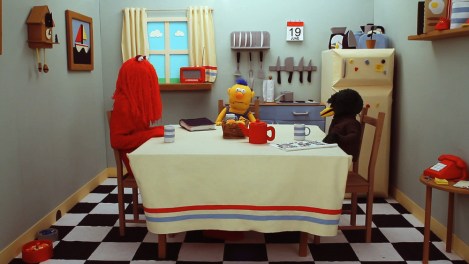
A couple days ago, one of my friends introduced me to the youtube series “Don’t Hug me. I’m scared.” Before she played it, she told me it was gonna be pretty weird and messed up. I have to admit, she was definitely right about that.
It starts out looking like a children’s TV show. Strange puppets in bright colors in a room made of felt and fabric, all in a Sesame Street kind of style.
Every episode follows the same pattern. It starts out somewhat normal, then a song begins to play. Each song addresses a subject that is important in today’s society. There is one about being creative, one about time and aging being unstoppable, about love, technology, health, and one about dreams.
Those don’t sound weird at all, do they? Well, just wait.
Because as the video goes on, the song becomes stranger and darker and more twisted, with loud noises and abrupt animations and a surprising amount of blood and death.
Honestly, I don’t even know why I started watching it in the first place. However, I was actually quite impressed by the deeper meaning of the show. Don’t get me wrong, it is creepy and messed up in so many ways. But I like the way it addresses things such as the brainwashing by mass media.
The way that all the “harmless” things and characters in the videos turn into literal nightmares- consuming your entire life, the way the characters get trapped inside a computer- and killed when they try to escape, or how you can only be accepted by people around you by joining the cult of love perfectly captures certain things that are wrong with our world and society, in an extremely twisted but ironic manner.
I don’t necessarily recommend anyone to watch this show, since I’m not really sure if it was or wasn’t a complete waste of time, or if the producers actually meant to be that deep. But in case you are looking for a great way to waste time, just watch it! It is definitely unique.
Amelia was city-made and city-grown. From where she lived the city was just a writhing mass, gridded like a chessboard, and full of monotony. Her circuits were overstimulated. She was surrounded by wires, cords, and progress. She was living modernity and on clear days she could almost feel like a part of the masses, she could almost feel like she interacted with them. Almost.
Frank wandered the city, cataloguing every face and type like a child seeing the world for the first time, walking a new language, but the people seemed to pass by him – no, look through him, like he didn’t matter. In truth, he began to think, do they really matter to me? But as he took another sharp corner, his mind clipped the edge of the building and then lodging was on his mind. He was in the right district given the signs hanging above doors and out from awnings, but he soon found he barely had enough money to stay the week out. How strange that what had had so much value previously in his life was so empty and useless in exchange here in Harborside.
Amelia was coming down from the clouds about to face the world for the first time, naive and one of the richest and rarest people in the city, but equally mysterious. Her mind had yet to grasp value; everything to her was bought and categorized away into an advanced filing system of uses.
Photo Credit: ashleyhooper3d.wordpress.com
The sky filtered into her windows, if she reached out, the clouds almost reached back, but who cared about clouds when she was going down to the ground.
From Amelia’s window far above Harborside its postcard appearance was breathtaking, heart-stopping from the aerial view, perfectly aligned like an OCD wet dream – but beyond the picture perfect Harborside was its dark truth, its fingers, its slums. Where the roads wended their way around makeshift homes, bodies being consumed by the cobbles of the city. The roads staggered like a drunk artist’s footsteps. The slums belied truth, the reality of the city for the majority. The true artists, the ultimate image of life, a slow burn out. The truth was, the city moved too quickly for anyone – even the top Moguls and Traders – to live contentedly, too fast for them to not eventually blend into the tapestry of time, of the city.
But while Amelia’s elevator sunk level by level, Frank’s feet were dragging him from job to job, ebbing closer and closer to that blight, the narrow streets, the moss, the dark sky, the forgotten, the true heart of the city. The cost of living had drained Frank, his week was up. Once a private person, he now broadcasted all he could, he needed all the help he could get. He dreamed of the past. When he was well off in the country, people tipped their hat to him, they knew his name, they cared. He dreamed of a city long past, just emerging from the harbor, crawling onto land like a new life form, full of opportunity and riches. His feet were carrying him further from the monoliths of global life. From the masses that thrived on standing out from the crowd, from the masses who had found what they sought, or at least the veneer of what they dreamed.
Below Amelia and beyond the borders of her glass and marble version of the city, the eyes of the workers were cast in coal and ash. Those of the slums were fading out of being, becoming just blurs, wisps of subconscious, hollow. They were being emptied of dreams, emptied of light, emptied of value. They looked – with light-burned, cataracted eyes, weary and broken from too many hours in front of a forge – toward the city they had dreamed of, the one they believed in, the one they were now part of, the one now using them as a whetstone to hone itself upon. They looked upon a city alien and yet familiar; one that shared the same name, shared a people, but was separated by a wall of prosperity, an insurmountable barrier of capital value.
Rising above Frank was the very tangible feeling of success and dreams realized. Above him – wrapped in their own private worlds, curtained off from each other – lay the world of Traders and Merchants and Moguls. There was no lost space, everything was worked to perfection, commodified and able to be owned. People had become slaves to their Ikea nesting instinct, they simply filled the space given, even the ultimate consumers did not own their space. The streets were wide and clear, everything at a crisp ironed angle, a city of well pressed pants. Those who walked them did not know each other beyond image: a Trader by the scale lapel pin, an Artist by the garish socks, an Economist by the gloves, a Mogul by the hat. On the great rising monoliths movies and media played, any new information came from those gargantuan marble monoliths. The world beyond Harborside was found in those rising towers of media.
But in the slums – from the roofs of their squat and makeshift shanties – the workers could just glimpse the edges of media. Their world was full of cracked screens and secondhand news. People were cramped, the heartbeat of one encroached on the next. The global world had all but disappeared to them, where they had come from was being wrung from them as they became just another road stone in the city. The cultural identities they had brought with them, had created neighborhoods around, had found their first jobs with were bleeding away. They were becoming the masses of the city, overwhelmed by the need for money, the vast cost of living had ensnared them, had separated them and pinned them by the wings.
Photo Credit: pinterest.com
But the global world existed only in the harbor with the monoliths of media, with the bustle of trade, it was rich and thriving in the harbor. Money was not lacking, it seemed as if the less work one did the more money filled their coffers.
Frank was well off for a country boy, so when he docked in the sand of the fish market – the only place his little decrepit rented dinghy could -he was sure he could do anything he could possibly hope for. As he jumped from the boat he sunk to the knee into rotting, bloated, sun-blistered fish waste. His nose crinkled, What a welcome. He trudged upward into the city, tapping his breast pocket with a light rhythm. As he reached the paving stones his tapping ceased, he could not crane his head far enough, the city just kept going. The longer he stared the more his past months at sea ebbed away with the tide; his past was being drowned out by the sounds, the smells, and the people. The city was made of individuals from the ground, Frank was just another one of them, just another in a sea of people striving to flourish as themselves, he was just dressed a little more shabbily, a little more wide eyed, a little more idealistic, he was just a little bit poorer, he was just woefully unprepared. So he set out to wander the city, to find himself, or lose himself.
It was dingy as hell, not recognizable as the city everyone saw in the postcards: moss and algae crept down the walls; the side streets were lined with open sewers; the factories ran all hours of the day, belching out waste and haze. Soot streaked down the faces of the workers whose hands were cracked and brown with exposure. What little they had they called home, whether roof or coat, they took what they could. They struggled through narrow congested streets, seemingly stuck in the past — a bygone era, that had long since been passed by the rest of the city — an open sore without medicine.
On these congested streets lived all manner of discard: tech no longer current, factory waste, dreams of fame and fortune, the relics of the country people once left, heirlooms of cultures long swallowed. But as the streets turned oceanside they widened and lightened, the haze of smog dropping away the closer one moved to the harbor, the mecca of trade, the jewel of the city, the picture perfect postcard. Harborside was a world of glass and gold that rose high enough that those with bloodshot eyes and wasted dreams believed that maybe it reached heaven.
The city of Harborside was rich, modern, urban, cultured, and only surface deep. Every man, woman, and child that lived in the skyward reaching world was a dreamer, a planner, a story. Their streets were lined with rare plants and their roads paved with exotic shell. Every home was its own, sitting pretty at the height of progress. They would want for nothing and everything.
Such severance was there in the city of Harborside that it was as if a blight, a disease, had been stretching out from the landward outskirts of the city but had abruptly hit a vaccine three quarters of the way toward the harbor. It was as if an immunization had been injected into the sea and had spread to the seafront but had been content to protect the few.
Photo Credit: steemit.com
Life was bobbing at a sea-sickening rate as Frank finally found the city. He had taken every form of transport available to him: car, bus, train, plane, his own two aching feet, bicycle, and finally boat. As the city rose over the bow of the leaky, decades-old fishing boat, the tug behind his gut seemed to loosen. The folded postcard in his breast pocket was a molten brand of hope and childlike optimism on his heart.
Life had ground to an overly warm stagnate existence for Amelia. Trapped above the cloud level – in a glass box – Amelia had the entire world at her fingertips. She was at the height of modern technology, she was as mapped out as the best planned city. There was no one like her, there never had been another like her, nor would there ever be one like her. She was a road map. She was not her own. She was caught, ensnared. Made and unmade.
As someone who loves to go to concerts and broadway musicals, I absolutely hate when people take advantage of people’s love for these to get extra money.
This pisses me off to an extreme. As someone who comes from a family with enough money, I shouldn’t be complaining about not having the money to go to these shows, and that’s not what I’m angry about. What I’m angry about is that originally the tickets to these shows are easily affordable, but not when greedy people buy these tickets and drastically increase the price to collect a few extra bucks from people.
Over the summer, Lana Del Rey announced a small concert in Anaheim, just twenty minutes from where I lived. I was ecstatic. I wanted to see her for the longest time, and my uncle had allowed me to attend the concert. The tickets were only fifty dollars, a reasonable price considering the majority of her fans are probably teenagers without jobs. I preordered the album, and at 9:59 I was ready to buy the tickets that went on sale at ten o’clock. Not even twenty seconds later, the tickets were sold out. It was upsetting, but when I checked every single resale site I could it only made me more furious. The tickets were being sold for ONE THOUSAND DOLLARS. From fifty dollars to one thousand dollars. When I went on twitter in hopes to find someone nice enough to sell the tickets for a more reasonable price, they were all over 400 dollars.
I figured out that I wasn’t alone with my absolute annoyance over the dramatic resale of these tickets. It’s amazing how the people who were selling these tickets for unreasonable prices are probably the same people who complained about this same problem when they weren’t able to afford to go see their favorite musician.
For a more recent example, over the weekend my aunt was planning on buying tickets for Hamilton. Originally, the tickets are around $200, which is a reasonable price for the most popular show on Broadway. However, at resale pricing, tickets in the back row are sometimes at least $500.
Photo Credit: NYdailynews.com
It’s absolutely selfish, because these scalpers know how much people want to go to these shows, and how much people are willing to pay. People shouldn’t have to pay so much money to go to a show, especially when, in the end, the extra money is going to the seller and not even the show being played. It’s more bothersome that people actually end up paying these high costs for the shows, and only fuel these people’s beliefs that they can actually cheat people out of valuable money by manipulating their want to go enjoy these shows.
So, to everyone reselling these tickets at high prices to make a couple extra bucks: stop. Because as a sixteen year old girl who just wants to go rap concerts, historical musicals, or wear flower crowns at small Indie concerts, it’s upsetting when I can’t add some happiness into my life, because these tickets cost twenty times more than the amount in my checking account.
A tight backstage room.
Fumes from hairspray intoxicating a tight backstage room.
Chaos,
bobby-pins, tan and black,
flying aimlessly.
It is hot backstage,
the walls the color of earl gray tea.
The toes of the apparently perfect, are broken, bruised, concealed inside pretty pink slippers delicately touching the chalk buckets in every corner of the room.
Pandemonium.
Bustling people elegantly dressed in every color imaginable.
Feathers,
diamonds,
flowers,
leotards,
point shoes,
tights,
tutus.
Dancers racing around behind the curtains struggling to find their cue.
The frightened ballerinas pacing backstage,
with visions of turns and leaps dancing in their heads.
Dance ballerina to the sound of the classical piano.
All the chaos backstage concealed from the elegance on stage.
All concealed from the wealthy parents sitting in velvet chairs.
Are you an LA Devotee? I am and have been one for a while. My dad is convinced that “Californication” was written about me.
For the very few that don’t know what that is, “Californication” is Red Hot Chili Pepper’s best song and an absolute must-listen. The song metaphorically refers to the California lifestyle that Hollywood is trying to sell, it shows us that lifestyle through films, tv, social media, and magazines. Making people believe that if you come to California you can throw your life away in exchange for endless partying.
The song also reveals that the California that people think of as glamorous and perfect is really just made up and fake. The music video expands on this idea. At the beginning, all the scenes look great until all that scenery just collapses. The band members are constantly running in the video and perhaps thats their way of saying that they want to break away from this life.
However, I don’t agree with that. My experience in California has been very different.
Yes, I do see plastic surgery addicts from time to time. I also see women in full makeup at 9 am carrying dogs under their armpits just to go to a coffee shop, as well as beautiful sports cars just stuck in LA traffic, never having an opportunity to reach their full speed as they’re supposed to. Yet, those people don’t make up LA for me.
I would argue and say that Los Angeles is the only big city where I can put on a white tee and some jeans and be able to go to a trendy restaurant. People don’t feel the need to show off their wealth unlike in cities such as London or Paris. I really feel like a part of this city. It has really grown on me. Or is it just Californication?
In an interesting turn of events, Ed Skrein, who was originally set to star in Hellboy, backed out of his role this summer because of his character’s mixed-Asian decent. Now, I’m upset that not enough people are talking about this. Hollywood is known for casting white actors in place for roles that are for people of color. However, Ed Skrein is the only actor, that I’ve heard of at least, that has declined a role because of this reason.
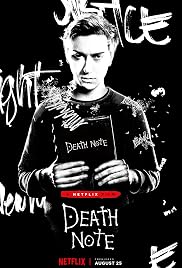
This is big news because of how rare it is. We’ve seen actors and actresses with amazing, prolific careers ignore whitewashing and accept a role that a person of color deserves. Earlier this year, Scarlett Johansson played main character Major Mira Killian, adapted from the Japanese manga series Ghost in the Shell. The movie barely saw any profit, less than 70 million made in its entire box office career. Matt Damon starred in the Great Wall, a movie literally about a white man leading a gigantic Chinese army against monsters attacking the grand fortress. Most recently, Netflix released Death Note, starring Nat Wolff, another adaptation of a popular Japanese manga.
Talking about Death Note for a moment, back in 2015, when Nat Wolff was announced as the film’s lead, Light, there were obviously mixed responses. One came from up and coming actor, Edward Zo, who was denied the opportunity to even audition for the same role. Why? Because he was “too Asian.” Here is his story below:
Something he said really stuck with me. “Hey, your story is really cool. Everything about this story is awesome, except you,” he said, when explaining what whitewashing feels like. What directors are doing is taking away the authenticity of a story. You don’t see white actors playing slaves, it’s not their story to tell. Manga, a style of Japanese comics, is quintessentially Japanese. Not white. What you get are stories that stay with Japanese adults and kids alike. Why take that essential part away in the movie version?
Photo Credit: imdb.com
What I just talked about are just actors stealing roles from Asian, more specifically Japanese, actors. I could show hundreds of examples of Hollywood whitewashing. Some older movies even use blackface and yellowface instead of just hiring people of color. What all these movies have in common nowadays are their social media outcry based on their faulty casting. I hope that Skrein’s decision and the obvious negative effects it has on a movie’s reviews will deter Hollywood from whitewashing in the future.
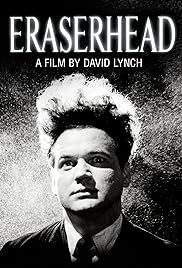
It’s October aka the Halloween month, so I thought that it’d be fitting to share and reflect on some of my favorite horror movies of all time. First, I’d like to talk about a rather peculiar movie that is Eraserhead. I first came across it when I was only twelve years old and it was also my first time diving into one of David Lynch’s elusive worlds.
The movie is Lynch’s debut work and it was first screened at the Filmex Festival in 1997. The plot tells the story of a single father, Henry Spencer, who has to take care of his mutant, deformed child. The setting is Lynch’s favorite- small and isolated, industrial town. However, most of the movie is an insight into Henry’s mind, full of hallucinations, nightmare-like sequences, and his dark fantasies.
Eraserhead manages to alienate the viewer from the real world into a dream world. Lynch perfectly depicts nightmare logic and that’s what makes this movie truly terrifying. This movie is also perfect if you want an authentic insight into Lynch’s mind, he directed, produced, wrote, edited and designed sound for Eraserhead. Lynch refuses to explain anything to the viewer, however, he did say that he still hasn’t read an interpretation similar to his.
I would highly recommend this disturbing, claustrophobic body-horror classic. Perhaps, you might be the first to have an interpretation that matches Lynch’s.
It was oppressively hot, but it was worse inside. The idea for the party had been born earlier that month, straight out of the heatwave, full of desperate loneliness and braised, salted wounds. He had thought that the heat had been bad when the party was thought up but it had gotten worse, the end of summer was supposed to bring promise of a cool refreshing fall, but instead the dog days were holding on.
Partygoers were wilting like flowers, falling and rising in dance on a phantom wind born and nursed by too-expensive-booze, and sweat dampened morals, the peace was tenuous. It was just too hot for a party, even the breeze was like licks of fire on his cheeks.
The rail of the balcony scorched his forearms, but it was better than dancing in the heat. He dropped his head back and looked for stars he would not find, but before the search even truly began the click of heels sounded behind him, the echoes of a last ditch S.O.S in consistent and aggressive morse code.
He did not look, she came up to the railing next to him. He still did not look at her, but in his peripheral he could see she was reasonably tall, dressed in unseasonal black, sleek. She inclined her head and stared out into the darkened hedge maze below them, all shadow. He could sense her grace rather than see it, there was something indescribably elegant in her presence, but she was incredibly still. She was pensive in a way that only people dressed in finery and malcontent can be.
She looked on as a couple stumbling their way through the doors below them, tipsy, glittering and very much in love made their way into the maze. Both were dressed in crisp autumn colors, one a in deep burgundy gown that splayed behind her like a trail of fire and the other in a warm burnt orange that fell like water.
Photo Credit: previously.tv via Penny Dreadful
Two leaves dancing in the too warm night, lost to the world and unregistering of the weather outside of their perfect dichotomy.
She glanced sideways up at him through the leaden air, her sharp, slanted eyes caught him off guard, caught him staring at her with the sideways glance of someone interested but unwilling to admit it, but her interest was clear.
He slid his eyes lazily away and turned so his back was to the railing. She turned her head to see his profile, if he glanced at her out of the corner of his eye again he would see almost her whole face, a dangerous temptation. He hadn’t really seen her yet, the tendons in his neck lightly pulled him to look at her, but he resisted, he vowed not to look. He didn’t want to talk to anyone, especially not at this party.
She sighed, a light huff of hot air in the even warmer atmosphere around them, the air around them weighed heavy on him, even the light seemed dragged down. She leaned her narrow gloved hands on the bannister the stem of a champagne flute nestled in her long, lithe fingers.
She was made of long lines like an artist had just drawn out the essential curves in stark black strokes, she flowed like fine ink.
She swirled the champagne in her glass, light winked off it catching the light like a star on earth.
“This is the expensive stuff and what a glass to put it in.” Her voice was low and rolling over him, lulling him into a stupor, “The cost of the wine almost justifies the dressing up, but this glass, the glass definitely justifies the dressing up.”
A sudden shattering caused his trance to break, his vow forgotten his head snapped to look at her.
From her elegant and bewitching fingers the glass had fallen, no, he realized as he looked at her small smirk in profile, the fine crystal glass had been dropped, on purpose.
A galaxy now lay on the stones beneath them, the leaves in the maze had also turned suddenly at the clear cold noise cutting through the heat, but they were once again lost to themselves within moments.
He was now staring into her eyes, unable to look away, pinned like an insect to a scientist’s board, her dark brown eyes looked almost black under shadow and tapered lids.
He spoke one word, his voice rusty and thick with the overly warm air, “Why?”
She glanced down and turned on her heel, her sharp cheekbones and nose flashed in the light of the windowed doors she was headed toward, now that he had looked at her he could not look away. Those inky outlines were nothing on the amorphous night she was truly made of.
“So you would look at me,” she walked through the doors then, the promise of a cool fall night disappearing into the light of a too hot summer party.



 OVS Journalism Blog
You must be logged in to post a comment.