Opinions, likes, and school walkouts

To begin,
For all of my peers who participated in the national school walkout today, I want to thank you for standing up for what you believe in and being catalysts for the change that our country so desperately needs. We know what kind of world we deserve to live in, and we are making it a reality.

Credit: TruthRevolt.org

Growing up in an age of technology, social media and internet access can be a double-edged sword of sorts. We can use our technology as a platform for positive things, like spreading awareness and voicing our opinions on all sorts of matters. But, that can also result in a nearly obsessive need to receive validation for our experiences. This validation comes from documenting and posting about almost anything that occurs and is worthy of being noticed.

This dichotomy poses a question: If you don’t post about it does it even really matter?

I’m not trying to be cynical, I’m just genuinely curious if that is a justifiable way of life. I’m not saying I am immune to it, but I would also like to think that I’m not dependent on my social media, nor do I find validation solely through it.

Something I noticed throughout the protesting that took place today is a lot of people seemed to have no idea why they were a part of it. Sure, they knew that it was in honor of the seventeen victims of the Parkland shooting, but they were mostly participating just to follow along with everyone else.

Credit: Polkscan.com

I received several messages, posts, etc. talking about the protests and ways to be involved, which I appreciate, but in lots of ways they all seemed so disingenuous. I am fully supportive of young people’s activism. But when you send me snapchats of yourself wearing an orange t-shirt to “show ur support!” I can’t help but think that you really have no idea what you care about, you just want me to know that you “protested.”

When asked what you believe, you can give a coherent reply. But when asked why you believe it, you have no idea.

It’s almost as if you don’t even care about the victims of all of the past shootings, you don’t even know why people are fighting for stricter gun control/laws. You only care about how many likes you got or how many people viewed your story.

Being a part of a protest itself (actually being an active activist) should be validation enough, it shouldn’t need to be found on instagram. But maybe that’s just the way I look at it.

So, yes, I understand and agree with the fact that social media can be used to spread awareness and to generate change. I also realize that these walkouts were fueled by social media, and that without it we wouldn’t have accomplished such a large-scale and widespread protest. But when half of the people I see posting have no idea what the significance of it is, it just makes them seem ignorant and it takes away from the importance of today’s events.

It is inspiring to see so many young people who already have such strong opinions. But if you have no idea why you have certain beliefs, if your beliefs don’t have a purpose or a foundation, then you might as well not believe in anything.

In order to be effective you must first be informed.
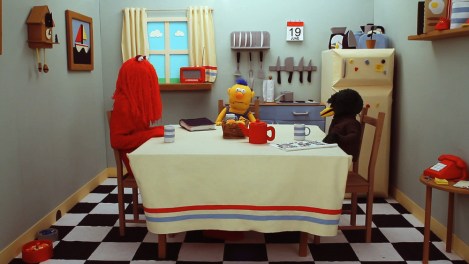


Don’t hug me. I’m scared

A couple days ago, one of my friends introduced me to the youtube series “Don’t Hug me. I’m scared.” Before she played it, she told me it was gonna be pretty weird and messed up. I have to admit, she was definitely right about that.

It starts out looking like a children’s TV show. Strange puppets in bright colors in a room made of felt and fabric, all in a Sesame Street kind of style.

Credit: static1.squarespace.com
Credit: images.genius.com

Every episode follows the same pattern. It starts out somewhat normal, then a song begins to play. Each song addresses a subject that is important in today’s society. There is one about being creative, one about time and aging being unstoppable, about love, technology, health, and one about dreams.

Those don’t sound weird at all, do they? Well, just wait.

Because as the video goes on, the song becomes stranger and darker and more twisted, with loud noises and abrupt animations and a surprising amount of blood and death.

Honestly, I don’t even know why I started watching it in the first place. However, I was actually quite impressed by the deeper meaning of the show. Don’t get me wrong, it is creepy and messed up in so many ways. But I like the way it addresses things such as the brainwashing by mass media.

The way that all the “harmless” things and characters in the videos turn into literal nightmares- consuming your entire life, the way the characters get trapped inside a computer- and killed when they try to escape, or how you can only be accepted by people around you by joining the cult of love perfectly captures certain things that are wrong with our world and society, in an extremely twisted but ironic manner.

I don’t necessarily recommend anyone to watch this show, since I’m not really sure if it was or wasn’t a complete waste of time, or if the producers actually meant to be that deep. But in case you are looking for a great way to waste time, just watch it! It is definitely unique.

AC/DC

“Highway to Hell”…”Dirty Deeds Done Dirt Cheap”…Nikola Tesla…Thomas Edison.

The age-old debate of Tesla vs. Edison.

While many don’t care and are just thankful for rock music, we should light the debate on which inventor is better.

Edison is the forefather of direct current (DC) and believed that Tesla was insane for even suggesting alternating current (AC), but in the modern world we live in, AC/DC currents are symbiotic.

The fuel added to feud fire is the rumor that Edison claimed he would pay Tesla $50,000 dollars if Tesla could improve Edison’s Dynamo, when Tesla worked for him in 1884.

Photo Credit: Think Geek

When Tesla succeeded, the rumor goes that Edison refused to pay him, claiming, “When you become a full-fledged American, you will appreciate an American joke.”

In the case of Tesla and Edison, sometimes people just rub you the wrong way. Both men were habitually egotistical but hated the quality in the other. They had vastly different work styles that constantly ran up against each other, and they ended up going head-to-head in fundamental electrical engineering beliefs.

I often wonder how the two men would react if they were able to see how their two ideas have been combined in the modern world.

Would seeing the symbiosis lead them to create another smear campaign, or would they nod in appreciation of the other and not say a word?

13 Reasons (Why?)

*WARNING: 13 Reasons Why spoilers*

About two weeks ago I sat down on my bed and opened Netflix. I kept scrolling and scrolling until, wait. I scrolled back up. In the Netflix Originals section there was a poster for 13 Reasons Why. I remember hearing so much hype for this show and seeing so many pictures from it. Not to mention, Selena Gomez, a producer for the show, raved about it on her Instagram a month ago. Almost impulsively I clicked play and listened to those first words, ringing through my ears.

“Hi, I’m Hannah Baker, live and in stereo.”

my dog eating a tangerine
Photo Credit: hollywoodreporter.com

I was instantly hooked and stayed that way until the last episode. However, by the time I was done, I was shaking and crying. No, it didn’t move me or inspire me to donate to suicide prevention lines. It gave me a panic attack. That’s the hook. The show slowly, mysteriously arises, making you want more. The end comes in flashes and ends with a bang.

Up until this point, I’ve loved most shows I’ve watched on Netflix. Stranger Things brought a retro spin on an eerie missing child’s case, and Netflix also revived some of my favorite shows from my childhood, like Degrassi and Bill Nye. However, 13 Reasons Why seems rushed and overly dramatic. They took Jay Asher’s book and made it a sloppy real-life version.

Obviously the show can’t be exactly like the book, explaining the various character changes, such as Sheri and Courtney, and depicting some timeline and technology differences. Of course, they had to spread out Clay listening to the tapes to supplement an entire season of episodes. It makes sense that they’d show different perspectives to create more depth and keep interest at bay. In 2007, when the book was originally published, social media wasn’t as popular as nowadays, which makes the technology advancement sensical.

That doesn’t explain why they changed Hannah’s suicide. When I saw her death scene, my stomach twisted into a pretzel, with a cold, hollow feeling. I started crying and hyperventilating. Yes, there was a warning at the beginning of the episode, but nothing could’ve prepared me for seeing her slit her wrists and bleed out in a bathtub. My full-body aching became worse when I found out that they changed it from Jay Asher’s original story. In the book, Clay simply mentions that “Hannah swallowed some pills.”

Some have said that this scene only makes the show more powerful. However, seeing something as graphic as that does more harm than good. In fact, Hannah’s suicide could be a risk factor for those on the edge. The American Foundation for Suicide Prevention states, “Exposure to another person’s suicide, or too graphic or sensationalized accounts of suicide” could be an environment stressor that could trigger a suicide attempt. While it is given that there will be mentions of suicide, it isn’t publicized that a graphic suicide attempt is present in the show.

Many mental health professionals have spoken out about the negative affects of this show. Along with Hannah’s suicide attempt, the story itself glorifies suicide. The entire show is buzzing all around social media for its amazing cast and storyline, so it’s hard to detach it from all the talk, to talk about what it’s actually worth.

The entire premise is that a girl kills herself and blames it on other people, which is usually the opposite of what actually happens when someone takes their life. There is usually a feeling of helplessness and worthlessness, but suicide is (and always will be) the choice of a single individual. Viewers also miss the internal struggle that most people on the edge experience – the constant back and forth decision-making of whether or not they’ll commit.

Other less prominent issues are in play. Clay’s childhood friend, Skye Miller, tells him that suicide is for the weak and cutting is for those who are strong. Despite being grotesquely wrong, this glorifies self-harm, as a “strong” thing to do. Self harm is never a healthy, safe choice and can cause numerous health problems, besides leaving scars. The school’s health counselor’s, Kevin Porter,  lack of training is appalling. He doesn’t recognize obvious signs of Hannah’s suicidal thoughts and doesn’t report that she was sexually assaulted after he pressures her into giving out the name of her assailant, which she refuses to do out of fear. This scene will discourage many students to seek help in times of need, which could cause many lives to be lost.

Finally, Alex’s suspected suicide attempt is unnecessary and a cheap way to obtain a second season. He obviously exhibited signs of suicidal ideation, but this was uncalled for. The story has no mention of Alex killing himself and for a show that wants to honor the original story, this makes zero sense. My hope is that if they make a second season, they will be more aware of how to handle his suicide in a more appropriate (and less triggering) fashion.

For what its worth, this show does open up a dialogue about suicide awareness. While the information in this show isn’t all factual, it at least depicts suicide as a very real, very horrible thing. If you or someone you know is considering self-harm, please get help. Call the National Suicide Prevention Lifeline at 1-800-273-8255.

World’s First Head Transplant Surgery

Photo Credit: CBS

It has been announced that the world’s first head transplant surgery is scheduled for December of this year, a surgery that could be a turning point for modern medicine and people alike. The surgery is set to be preformed on Valery Spiridonov, who has Werdnig-Hoffmann disease which leaves him unable to stand or walk.

The surgery, that is estimated to be at least $10 million, will last for approximately 36 hours. The condensed plan of the surgery from A Person Who is Not Very Scientific is that the doctors, Sergio Canavero and Xiaoping Ren, will cool Spiridonov’s body to 50 degrees Fahrenheit, and cut off the heads of Spiridonov and the donor at the exact same time. Then the doctors will somehow connect the spinal cord and nerves from Spiridonov’s head to the donor body.

Many transplants like this have been done with animals, but most have failed and many are skeptical of the upcoming risky procedure.

How have video games impacted modern culture?

Photo Credit: ow.battlenation.ru

1.2 billion people identify as gamers. Currently, 700 million people are playing right now. 46% are female and the rest male. Females tend to like games such as word games, puzzles, dress-up, and ones where you care for pets, while males tend to like ones about action, racing, and sports.

Even if you only play Angry Birds, you’re a gamer – just a casual one.

World of Warcraft is arguably one of the biggest digital games ever made, so big it created its own worldwide subculture. Gaming is a career. The highest earning gamer earns 1.5 million dollars a year. Video games have created memes in T.V., movies, stand up comedy. In Germany, there’s a T.V. channel dedicated to games, and in Korea there are two cable T.V. stations committed to games. 

Movies have been made based on games, like Warcraft. Celebrities like Robin Williams have advocated for gaming and love to play. There’s even a memorial for him. Van Diesel, the late Paul Walker, and Cameron Diaz all play and have talked about it. The financial impact of gaming is that the music in games reaches huge audiences, like the Wow theme song. 

 There have also been bad effects of video games like anti-socialism, in which gaming has changed the way people live and interact. 

Video games – could they be a sport?

Photo Credit: Performgroup.com

There’s a lot of controversy surrounding whether Electronic sports, or E-sports, as it’s called, should be considered a sport. Competitive video gaming has seen immense growth in the past 10 years, as technology has allowed companies to make better and more immersive games.

The platform for E-Sports has grown like crazy – E-sports events have more viewers than the NBA Finals, and the numbers are closing in on the famous NFL Super Bowl. In 2011, E-Sports and game streaming start-ups alone have raised up to 714 million USD. During the Starcraft finals back in 2011, the viewership was stunning as it had up to 3.5 million people watching around the globe. Since then, the viewership of E-Sports has risen more than 300% to a stunning 11.7 million people watching the recent Pro Circuit Championship in 2012. The prize pool for these events can go up to the hundreds of millions of dollars.

Some parents who once discouraged their kids from playing video games now see the potential they have for earning higher salaries than professional athletes by playing video games as their job.

So, is gaming a real sport? I think so. It requires strategy and critical thinking, and also a lot of stamina, just like sports. E-Sports athletes often retire by the age of 30-35. It’s demanding. For those of you who disagree, I would like to formally welcome you to the digital age.

Virus Found

In the 21st century, digital security has been one of the weakest points in countries and companies worldwide. Digital security has been emphasized during this Presidential race, with Hillary Clinton’s emails being leaked. But just how far can the U.S. implement digital security? The answer is bleak, with billions of devices connected to the Internet constantly, and with little to no security being applied to the majority of these DVRs and routers. This mass of technology with no security has been the worry of many computer experts.

 
These worries were fulfilled on October 21st, when a massive attack brought down a large company that monitors and routes Internet traffic called Dyn. With the fall of Dyn came the fall of Netflix, Twitter, and Etsy as well, for a few hours.

 
This attack was coordinated by using thousands of hijacked devices that spewed millions of nonsensical, invalid messages on the servers overloading them. This attack is known as DDoSing. These attacks will only become more often and voracious with a new software that’s becoming global.

Photo Credit: welivsecurity.com

(Here are the regions of the U.S. most heavily impacted.)

A botnet-creating software called Mirai was used to create this massive attack. Mirai first infects the home computer through emails, and from there spreads throughout all devices connected to the router, and these viruses remain in the hijacked devices. Even if the virus is deleted from your computer, there may still be dormant viruses across the house, waiting for a command.

Now, major websites have crashed, and there seems to be very little stopping this new charge of infection and DDoSing. Major companies have already recalled some devices that have minimum security, but there still remains many more devices defenseless. The rush to keep up with technology and stay ahead of viruses and attacks will be the largest struggle this coming century. This may just be the start of more problems demanding new solutions.

Breaking the Internet (Bias)

Photo Credit: http://www.marccx.com

Some adults nowadays blame technology for the current generation’s immaturity, saying that we’re obsessed or addicted to technology. Now, I’m not denying that we use quite a bit of technology, but I don’t understand how it is seen as so terrible. Kids now have an outlet that adults didn’t have; but that’s all technology is: an outlet. Kids aren’t obsessed with technology because they want to waste their lives in front of screens, but because those screens can make their lives better

TV shows allow children to escape their lives and fall into different ones. Whether it be a show about rich, teenage socialites or FBI agents solving crime, they can temporarily forget the next test or project. Children can take a break from the stresses society places on them and dive into this new fairy tale.

Music isn’t a way to defy adults and headphones aren’t a weapon of that defiance. Rap songs, however vulgar to certain listeners, can give a narrative to a child going through the worst. The same goes for a child who drowns out their inner demons with rock or metal. Pop songs aren’t these three-minute snippets of lifeless beats and strums, but rather anthems that give children something harmless to identify with.

And while social media has its own problems, these websites allow kids to find people who are experiencing the same struggles. It is amazing how many grief support groups there are online. Even though teenagers don’t always see who they’re communicating with, the advice given to them can help make a trying situation that much less difficult.

Finally, if it weren’t for adults, the Internet and all these “harmful” websites wouldn’t have even been created. Children aren’t the CEO’s of Netflix and YouTube and they shouldn’t be ridiculed for simply enjoying something.

(Read more positive effects here.

Have Humans Become Gods?

Have humans become gods?

Over the course of 200,000 years, Homo Sapiens have managed to disintegrate every other Sapien including Neanderthals who lived on the Earth 20 million years, but does anyone weep for the Neanderthal?

New technologies and discoveries have been opened to humanity, allowing mass agriculture to large machines that run off of electricity. We harvest electricity from intricate devices that we’ve developed to harness the world and even the sun. This is all considered human progress, but where could the next frontier be?

Last year a new technology has allowed us to push forward humanity further than ever before, to the extent of even seeming science fiction.

That new Technology is called Crispr.

Photo Credit: www.21stcentech.com

Crispr, simply explained, is a DNA archive saved in each cell that is more easily programmable due to its powerful protein Cas-9 which edits DNA. Before the discovery of Crispr, genetic engineering required years to perform and very deep pockets. Now it’s 99% cheaper and only takes a few weeks in an ordinary lab.

Soon new generations of Crispr will be innovated and gene modifying will become even cheaper allowing people in ordinary labs to genetically enhance anything. So sooner or later it will have an effect on everyone. For instance genetically modified food already exists but now it’ll be far easier to create new strains of crops larger and more resistant to drought. Starvation will become less of a problem even in developing countries whom get their hands on these new strains of wheat or rice.

Entire new menus will be created over the next few decades including new tastes and healthy food just as delicious as ice cream. Mutating animals through selective breeding has been ongoing for thousands of years, far before agriculture. Attempting to change their DNA has been attempted for the last fifty years but now it’s cheaper and easier to do.

This genetic door that has been opened will help the fight against diseases or defects as we develop genes in mosquitoes to deny and attack malaria or create white blood cells that are more efficient in killing cancer cells. Yet with all the shining promise,  there’s a much more controversial side to this, such as genetically modifying humans.

Many believe that Darwinism has died and Idiocracy will rule the earth, however this isn’t as true as perceived. Already we have selective breeding of sorts where doctors may scan pregnant women and show that their children has down syndrome or other youth disorders. Many women decide to terminate the pregnancy. Research in Britain has shown a 30% dip in down syndrome cases. This is slowly eradicating the gene to extinction.

This genetic engineering may allow parents options to choose how their children look and how intelligent they are. Letting human course run its natural path will no longer will occur as modified humans are born and inevitably pass on their genes in the population. Then there is cloning, where in sixty years it may be possible to have an army of genetically modified super soldiers. This not only hits the heart and minds of science fiction lovers, but now is truly a controversy that humanity will be debating for the rest of its existence.

Blurred lines on what is morally right and wrong haunt the idea of genetic engineering, especially in the polarized U.S. However, no matter what laws are set, humans will start adopting body modifications with or without governmental permission. Allowing a disconnect between the government and genetic research can be hazardous for everyone. So keeping a keen eye on this research may be the only road to take.

This door which humanities shoved their foot into no longer can shut. Just as inventing nuclear weapons, you can’t simply delete it. People may think “okay, let’s ban human genetic modification and cloning- it’s too dangerous.”

That’s easy to believe, but look at in another perspective. Why would you impede human progress? Let’s say with mass production in one hundred years you’ll be able to buy super sight for an easy sale of 100 dollars(no inflation). There are now no diseases and the average human life expectancies triples; people may now even look younger as scientists fight against the side effects of aging. The average human has an IQ of 135 due to wide-spread designer babies and personal preference mutation.

With genetic engineering, mankind pushes the boundaries of nature. Humans may truly create species and bring back dead ones such as the wooly mammoth. Life is truly limitless in the hands of scientists for the very first time. Humanity does gods work for him, so what’s to say we’re not gods ourselves?

Everyday, humans will have mods to themselves, anything they want or can imagine. While some will always resist this practically necessary change, slowly and over generations everyone in future existence will be changed. So, an interesting question to ask oneself is in five hundred years, will anyone weep for the ‘traditional’ Homo Sapien?