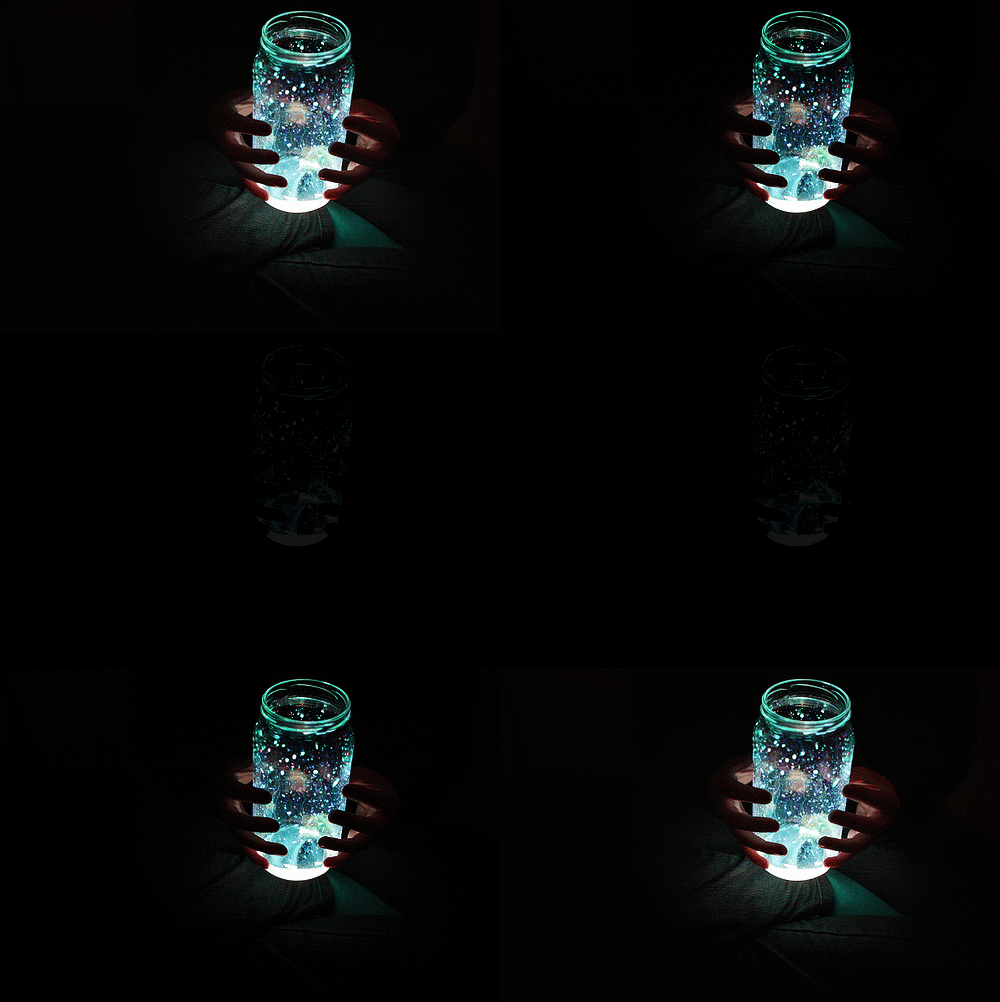
What if You Knew?

If only you knew.

I don’t know if it would change anything, I don’t even know if I would want it to. But from time to time, I find myself wondering: what if you knew?

Would I be the one wearing your jackets? The one that you’re waiting for when class is over? The one that you’d sit down with at dinner and who you’d tell how your day went? The one that you’d miss whenever I wasn’t with you? The one that could make you as happy as you’ve always deserved to be?

The thing is, you are happy. She makes you happy and I’m happy for you guys, believe me. You’re good for each other and I’ll leave it at that. I’ll never do anything to interfere with what you guys have, that wouldn’t be right. I know that. But, deep down, I still find myself wondering, what if you knew?

Photo Credit: lotl.com

Would you chose me over her? Probably not, there’s no way. She’s a 10/10. I’m, well, not. She’s with you, I’m not. If you knew, you’d probably think I was insane with no morals. You’d probably avoid eye contact with me for the rest of the school year until I leave this place behind, hopefully forgetting about how terribly difficult it is to see you across the room, wanting to be there with you, but knowing that, with your arm around her, you’ll never even consider me to be more than an acquaintance.

I hope you don’t know that I’m talking about you. I hope you’ll never know. But from time to time, I find myself wondering: what if you did?

No Name Woman.

This summer I read a story about the old traditional Chinese family back to the 1920s. It was called “No Name Woman,” extracted from the book “Woman Warrior“written by Maxine Hong Kingston. I was really shocked by the situation that Kingston portrays about her family.

The story is mainly about an American-Chinese family story in which Kingston’s aunt died in the family well after her child’s birth. Several years after her father and uncles sailed for America, “the Gold Mountain.” In 1924, her mother noticed that her husband’s sister was pregnant. Nobody said anything about the unacceptable activity, but the villagers had been counting and planning to raid their house. The villagers were violent and crazy. They were crying and tearing rice. “They also threw mud and rocks at the house,” the mother told the child. Even the animals were attacked and screamed their deaths. The villagers encircled them with horrific faces. They broke the doors and their knives dripped with the blood of the animals.

As a family, they stood together in the middle of their house. When the men came back, the family would build more wings to enclose the courtyard. However, the villagers pushed through both wings to get the aunt. They ripped up her clothes and shoes and broke her combs. After all they ruined the house and left with sugar and oranges to bless themselves. The aunt gave birth in the pigsty that night and the next morning she was found the baby “plugging up the family well.” The father denied his sister and the mother told the child not to humiliate the family by doing the same thing as his/her aunt.

As the story goes on, Kingston begins to have her own thoughts and finally thinks that her aunt’s story actually represents lots of old Chinese immigrants. She imagines all the past her aunt has been suffering until her death which she thinks might be what the old Chinese world is like back to the 1920s. She describes the world of her aunt which “at peace, they could act like gods, not ghosts.”(Kingston, “No Name Woman”) She regards the old Chinese world as her “no-name” aunt, who could not be defined and identified.

The end of the story is Kingston’s reflection about her aunt’s story. She said, “people who can comfort the dead can also chase after them to hurt them further – a reverse ancestor worship.”(Kingston, “No Name Woman”) I can feel Kingston’s confusion and struggle about what a real Chinese world was like in the old times and she spent her life trying to discover the truth of the society.

And after reading this story, I became more curious about the history of old Chinese immigrants. And I just want to know more about my family history, probably there is also a “no-name woman or man” in my family.
Who knows?

Zipped Up

Trapped.

Caged like an animal.

Can’t speak out for fear of punishment.

Must speak out for fear of death.

How do you live when you can do nothing?

Either way you are unhappy.

Words stuck behind the glass

Like finger paintings on a frosted window.

Flipped and confusing on the other side,

But leaves a mark in the morning light.