Recently I have been doing some self-reflection. I’ve found a few things that I want to work on, so maybe writing them out will help me incorporate them into my daily life. To my dear self, a few suggestions for personal growth:
1. Be present: Simply put: memories are better stored in your head than they are on Snapchat. Enjoy what is happening right in front of you.
2. Listen: Really listen to what people around you are actually saying. Don’t just nod along and then reply with, “Hey, do these jeans look better cuffed?” My hope is that this will help you to be a better friend and communicator.
3. Appreciate and enjoy: Don’t dwell on sadness. Sometimes life can be frustrating or boring and that’s okay. Make the most out of every day, appreciate even the smallest things. Don’t make excuses for why you can’t have fun today, just go out and find it.
4. Take care: You only have one body, one mind, one planet. Do your best to care of them.
5. Think before you speak: Mom is especially fond of this one. As much as I wish it weren’t true, how you say something impacts what you are saying.
6. Relax, no one cares: A while ago I didn’t order a drink I wanted because it was called “The Shangri-La,” and I was afraid of mispronouncing it and sounding stupid. The point is, don’t skip out on opportunities for fear of embarrassment. Most of the time, nobody is going to care, let alone notice, if you say something incorrectly. And even if you do mess up, just laugh it off – it’s what you do best.
7. Be yourself: Now I know this one is quite a cliché, but I think it’s important to remember. One aspect of this comes from my experiences with random strangers. Sometimes I find myself putting up a shy front when in public or talking with people I don’t know (E.g. the barista who could have made “The Shangri-La”). You are a social, people-person! Don’t be afraid to be friendly! You should be proud of that. This point is particularly important to keep in mind as you move through your teenage years, where so much pressure is placed on everything involving your personality, appearance, etc. No one ever got anywhere by being the same as everyone else. If certain people don’t like you for exactly who you are, you don’t need those people in your life. You will attract everyone you need for a supportive and fulfilling life by simply being you.
For now, this is all I have. Surely with time this list will continue to grow and improve – and hopefully I will, too.
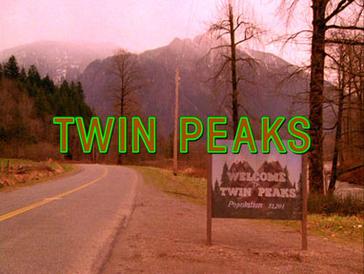
During the summer there was only one question on my mind: “who killed Laura Palmer?” The answer to that question can be found in episode 7 of the second season of my favorite TV show of all time, which is the surreal, mesmerizing and fever nightmare “Twin Peaks”. For those unfamiliar with the show -“Twin Peaks” is the brainchild of Mark Frost and David Lynch and it is possibly one of the best mystery drama series on television, and to prove that point, “Twin Peaks” received fourteen nominations at the 42nd Emmy Awards. When it first came out it dared to challenge boundaries of standard television, it had the eeriness of the “Twilight Zone”, the stylishness of “Miami Vice” and “Santa Barbara” relationship drama. The premise of the show is simple: an FBI investigation lead by Agent Dale Cooper is trying to unravel the mystery behind Twin Peaks’ homecoming queen Laura Palmer’s murder. The show isn’t solely one genre, it has elements of crime drama, supernatural elements and is also very campy. Drawing parallels from other works of Lynch, “Twin Peaks” is famous for surreal imagery, offbeat humor, and has a constant feel of violence that swallows you.
I can’t recommend this show enough, so if you have any free time on your hands please do yourself a favor and dive into the minds of Lynch and Frost and the haunting world of Twin Peaks.
i don’t get how everything i’ve built could be so fragile. just when you think your foundation’s set, an earthquake comes and shakes it. next a huge rainstorm. then a forest fire. or a tsunami. each disaster shakes the very thing you thought was solid. now my house is starting to crumble on contact. the walls a little less sturdy. the ground with a few cracks. but that’s why they call them natural disasters, because they have to happen. except they shouldn’t have to. you were a fire that didn’t naturally arise. you sparked something in me. i thought you were the soft ember in the fire-place, warming the whole house in a crisp, cold night. but you crept and crawled out, until the polished hardwood floor became singed beyond belief.
Photo Credit: chriscrespo.com
you burned everything. engulfed the second floor, filled with broken-down cribs and pictures lining the walls. you exploded in the kitchen, where everything was black and it wasn’t bad cooking. you burnt the living room, even all the memories made there, the many late nights, turned to dust. you left the backyard, full of brand-new spring blooms, dead. except it wasn’t all you. my house wasn’t fireproof. my foundation wasn’t concrete, it was loose pebbles. my walls were made of rotting wood. you barely made a scratch on my already damaged surface. so, while you sleep in your warm sheets in your warm bed, I’ll be shivering under my army blanket in a foreign homeless shelter, because you destroyed my only home.
You know that people will be leaving, projects are due, and so is all the school work from the past few months that you’ve hidden under your bed in denial. So I find myself strangely lonely, isolated even.
But I’m ready for summer, and my introvert battery needs a recharge. You’d think being “isolated” now would help, but it’s different.
Right now I’m isolated by work and change, in summer – recharge mode – I am isolated by choice and enjoyment of being alone. It’s different.
Photo Credit: npengage
Given the choice, I would skip the entire last two months of school, jump straight into summer and then into the new school year. But alas there are the last two months.
I don’t really like change, and maybe that’s why I isolate myself – at least I think it’s a self driven isolation. I hope it is, because the alternative option is that no one likes me. But that’s beside the point. I don’t like change because it takes me a long time to warm up to anything, and change is like a bucket of ice water on what tolerance and comfort I build up.
I’m not saying change is bad, I’m just saying I don’t like it. On top of that, I hate goodbyes. They’re often mushy and huggy and declarative, definite, final.
The end of the year approaches, and I feel kinda lonely and things are changing, fast.
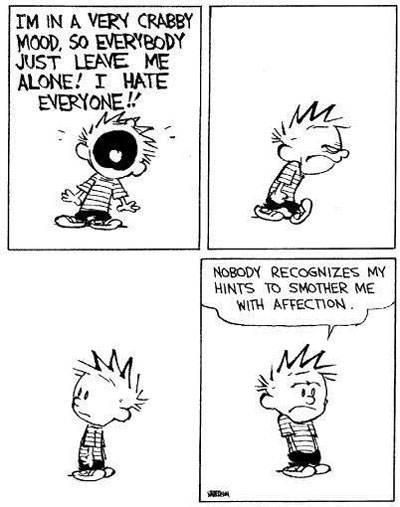
When I was in elementary school I first encountered Calvin and Hobbes. Since then it has resurfaced in various parts of my life surprisingly more and more topically.
Bill Watterson’s perennial comic often addresses the problems and anxieties of growing up, the pain of reality, and everything in between.
Watterson manages to cleverly address issues that still persist today through the eyes of the constantly adventurous and surprisingly observant six-year-old boy.
To this day, I find myself enjoying the comics in spare moments, pulling out weather-beaten copies with broken binding hoping to find a laugh or something to prove that I’m not just panicking, that growing up is indeed hard.
Watterson manages to perfectly characterize the angsty feelings of growing up and having to face oncoming reality, and sometimes it just makes me laugh and feel happy despite the panic I feel about having to continue to grow into adulthood.
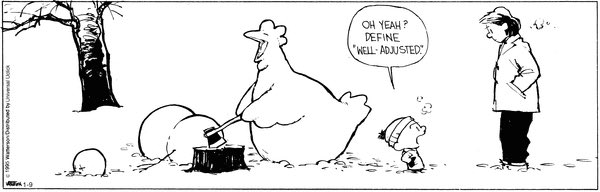
But my personal favorite remains the very last panel Watterson ever drew for Calvin and Hobbes:
If summer means free time and free time means reading, summer therefore means reading…and catching up on shows.
Summer fever has hit hard. With new books on the way and old ones staring me down, my fingers physically itch. My brain angrily pounds at the inside of my skull.
All I want to be doing is reading the Devils of Loudun or Sherlock Holmes or A Court of Wings and Ruin.
Photo Credit: Huffington Post
This year especially, I have had difficultly finding moments to read. I never realized how integral it was to my life and happiness.
Not that I’m not happy, but this year has weighed heavier. I miss reading all the time. I feel less like me, just a little more unhappy, busy, insecure.
I miss the years where I could a read a book – and I mean a substantial book – every two or three days.
I want it to be summer so I can get back to taking time for myself, soaking in different worlds, recharging from a full year of nearly constant work.
About two weeks ago I sat down on my bed and opened Netflix. I kept scrolling and scrolling until, wait. I scrolled back up. In the Netflix Originals section there was a poster for 13 Reasons Why. I remember hearing so much hype for this show and seeing so many pictures from it. Not to mention, Selena Gomez, a producer for the show, raved about it on her Instagram a month ago. Almost impulsively I clicked play and listened to those first words, ringing through my ears.
“Hi, I’m Hannah Baker, live and in stereo.”
Photo Credit: hollywoodreporter.com
I was instantly hooked and stayed that way until the last episode. However, by the time I was done, I was shaking and crying. No, it didn’t move me or inspire me to donate to suicide prevention lines. It gave me a panic attack. That’s the hook. The show slowly, mysteriously arises, making you want more. The end comes in flashes and ends with a bang.
Up until this point, I’ve loved most shows I’ve watched on Netflix. Stranger Things brought a retro spin on an eerie missing child’s case, and Netflix also revived some of my favorite shows from my childhood, like Degrassi and Bill Nye. However, 13 Reasons Why seems rushed and overly dramatic. They took Jay Asher’s book and made it a sloppy real-life version.
Obviously the show can’t be exactly like the book, explaining the various character changes, such as Sheri and Courtney, and depicting some timeline and technology differences. Of course, they had to spread out Clay listening to the tapes to supplement an entire season of episodes. It makes sense that they’d show different perspectives to create more depth and keep interest at bay. In 2007, when the book was originally published, social media wasn’t as popular as nowadays, which makes the technology advancement sensical.
That doesn’t explain why they changed Hannah’s suicide. When I saw her death scene, my stomach twisted into a pretzel, with a cold, hollow feeling. I started crying and hyperventilating. Yes, there was a warning at the beginning of the episode, but nothing could’ve prepared me for seeing her slit her wrists and bleed out in a bathtub. My full-body aching became worse when I found out that they changed it from Jay Asher’s original story. In the book, Clay simply mentions that “Hannah swallowed some pills.”
Some have said that this scene only makes the show more powerful. However, seeing something as graphic as that does more harm than good. In fact, Hannah’s suicide could be a risk factor for those on the edge. The American Foundation for Suicide Prevention states, “Exposure to another person’s suicide, or too graphic or sensationalized accounts of suicide” could be an environment stressor that could trigger a suicide attempt. While it is given that there will be mentions of suicide, it isn’t publicized that a graphic suicide attempt is present in the show.
Many mental health professionals have spoken out about the negative affects of this show. Along with Hannah’s suicide attempt, the story itself glorifies suicide. The entire show is buzzing all around social media for its amazing cast and storyline, so it’s hard to detach it from all the talk, to talk about what it’s actually worth.
The entire premise is that a girl kills herself and blames it on other people, which is usually the opposite of what actually happens when someone takes their life. There is usually a feeling of helplessness and worthlessness, but suicide is (and always will be) the choice of a single individual. Viewers also miss the internal struggle that most people on the edge experience – the constant back and forth decision-making of whether or not they’ll commit.
Other less prominent issues are in play. Clay’s childhood friend, Skye Miller, tells him that suicide is for the weak and cutting is for those who are strong. Despite being grotesquely wrong, this glorifies self-harm, as a “strong” thing to do. Self harm is never a healthy, safe choice and can cause numerous health problems, besides leaving scars. The school’s health counselor’s, Kevin Porter, lack of training is appalling. He doesn’t recognize obvious signs of Hannah’s suicidal thoughts and doesn’t report that she was sexually assaulted after he pressures her into giving out the name of her assailant, which she refuses to do out of fear. This scene will discourage many students to seek help in times of need, which could cause many lives to be lost.
Finally, Alex’s suspected suicide attempt is unnecessary and a cheap way to obtain a second season. He obviously exhibited signs of suicidal ideation, but this was uncalled for. The story has no mention of Alex killing himself and for a show that wants to honor the original story, this makes zero sense. My hope is that if they make a second season, they will be more aware of how to handle his suicide in a more appropriate (and less triggering) fashion.
For what its worth, this show does open up a dialogue about suicide awareness. While the information in this show isn’t all factual, it at least depicts suicide as a very real, very horrible thing. If you or someone you know is considering self-harm, please get help. Call the National Suicide Prevention Lifeline at 1-800-273-8255.
There comes a time in every senior’s career when they have to start picking colleges. Now, I’m far from being a senior, but I started thinking about colleges after going to the East Coast during spring break. Through all my time thinking about location, majors, and programs, one thing has stuck with me.
Photo Credit: breakthroughmiami.org
How are we, as children, supposed to decide the course of our lives? When someone chooses a college, they chose their connections, their future job opportunities, and many other hidden factors. When we choose a major, we cut off most of our time to explore other subjects of thought.
Picture this: You walk in to Ms. Oberlander and Mr. Alvarez’s college meeting. You sit down, take out your laptop, and open Naviance. You take a look at the colleges you’re thinking about. UCSB, Chapman, Harvard, or Yale. You have your target schools, but you know in your heart you’re dying to go to your reach school. You raise your hand to go to the bathroom, interrupting Ms. Oberlander’s speech about freedom.
It’s a little ironic. When most students go to college, they don’t know how to handle themselves. Just three months before freshman orientation, they still had to ask to use the restroom. They still had their parents doing their laundry and making them dinner. Teachers still told them how to dress, how to act. At OVS, we have the unique opportunity to learn some of the skills most college students lack so that we are more prepared to take on this new challenge.
However, OVS (and any school for that matter) can’t prepare us for what’s out there. It can’t prepare you for the choice between going to class or playing video games. It can’t prepare you for the people who will hurt you or how to make friends. They can only cross their fingers and hope you succeed.










You must be logged in to post a comment.